
Antiquing™ Stain
How-to-Guide
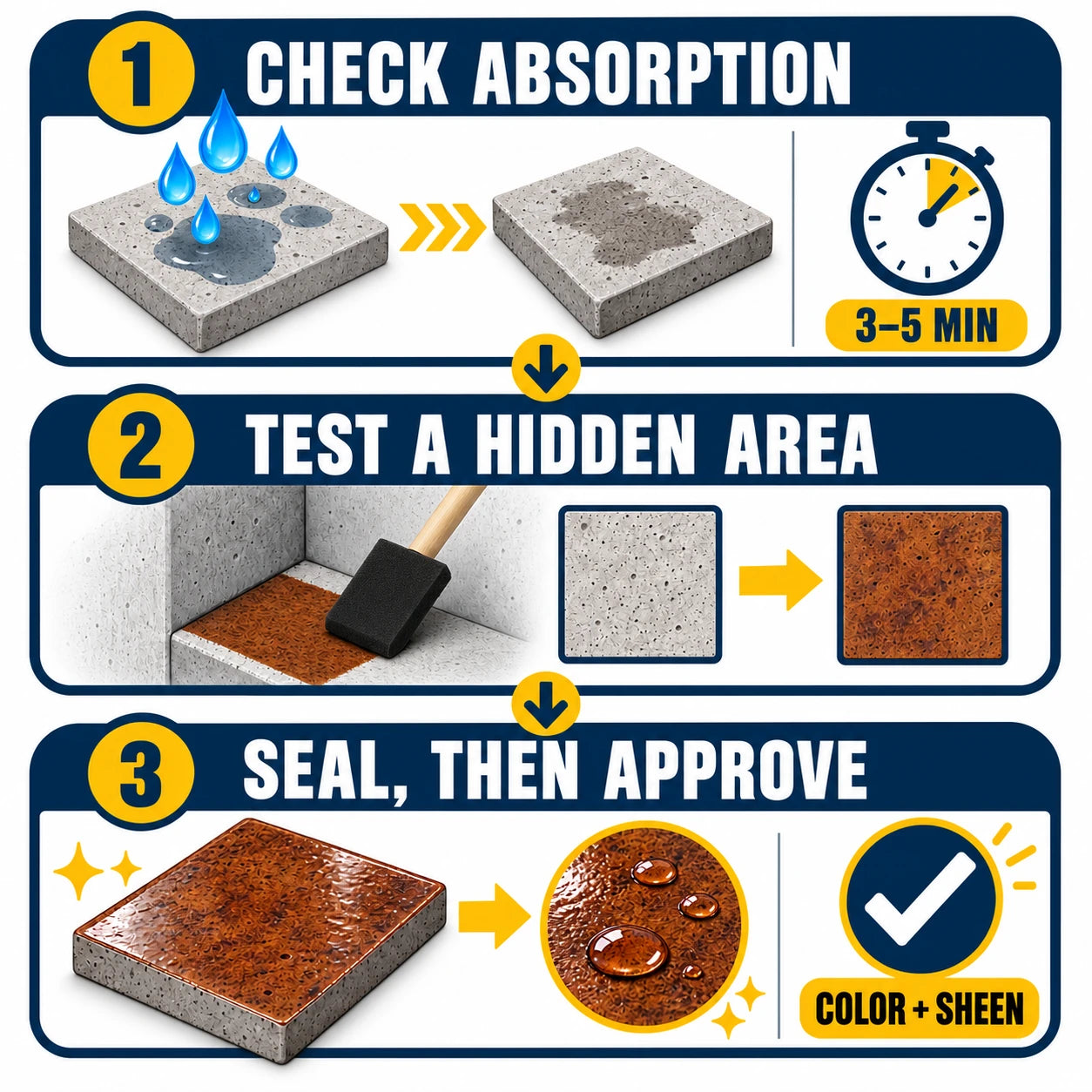
Test Before You Stain
Concrete varies in color, texture, and porosity. Before staining the entire project, test Antiquing™ Stain on a small, inconspicuous area. Prepare and apply the test exactly as you will the full project.
Before proceeding, confirm:
- Water absorbs into the concrete within 3–5 minutes. If it beads or remains on the surface, clean and etch or mechanically profile the area, then retest.
- The stain dries evenly and the pigment does not wipe off easily.
- After applying your selected compatible sealer, the final color and sheen meet your expectations.
Want to compare colors on your concrete before committing?
Is Your Concrete Ready?
Antiquing™ Stain performs best on clean, cured, sound and porous exterior concrete. Complete these five checks before beginning. If any check fails, correct the condition and test again before staining.
1. Clean and Coating-Free
Ready when: The concrete is clean, dry and free of dust, grease, oil, paint, adhesive, curing compounds, efflorescence, algae, mildew and previous sealers.
If it isn’t ready: Degrease and scrub the surface, rinse thoroughly and allow it to dry. Completely remove paint, adhesive and old sealer. Avoid acid washing, which may affect stain performance.
2. Fully Cured
Ready when: New concrete or cement-based overlays have cured for at least 28 days.
New concrete note: If a curing product was used, verify that it was an internal, non-film-forming cure. Film-forming curing compounds must be removed before staining.
3. Within the Temperature Range
Ready when:
- Air temperature is 40–95°F (4–35°C).
- Surface temperature is 50–85°F (10–29°C).
- The concrete is cool, dry and out of direct sunlight.
If the surface is hot or sunny: Wait until temperatures begin to fall. Hot concrete can cause bubbling, hazing and uneven results.
4. Structurally Sound
Ready when: The concrete is solid and shows no flaking, spalling, delamination or loose material.
If damage is present: Remove unsound material by grinding, shot blasting or another appropriate mechanical method, then complete the necessary repairs before staining.
Professional requirement: Concrete must have a minimum compressive strength of 2,500 psi.
Water beads up — NOT ready. Etch first with CitrusEtch™

Water soaks in and darkens — Ready to stain

All five checks passed? You’re ready to gather your tools and prepare the work area.
Gather Your Tools
You may not need every item shown. Build your checklist based on your concrete’s condition, the size of the project and your selected sealer.

Wear the personal protective equipment specified in the Antiquing™ Stain Safety Data Sheet. This may include chemical-resistant gloves, eye protection, protective clothing and appropriate respiratory protection.
Before opening the stain, make sure the work area is properly ventilated and all flames, pilot lights, sparks and other ignition sources have been eliminated.

Products and tools:
- ProClean™ Degreaser
- Pressure washer or stiff scrub brush
- Broom
- Mop and bucket
- Wet/dry vacuum
- Plastic sheeting or drop cloths
Why you need them: Dirt, grease, coatings and cleaning residue can prevent the stain from penetrating or bonding evenly.
Important: Do not attach tape directly to concrete. Secure protective coverings to walls, trim or other non-concrete surfaces.

Add these items only if water does not absorb within 3–5 minutes:
- CitrusEtch™ Concrete Etcher
- ProClean™ Neutralizer
- Chemical-resistant safety equipment
- Plastic pump sprayer
- Spiked shoes
- Stiff scrub brush or broom
- Mop and bucket
- Wet/dry vacuum
Important distinction: Etching can open dense, uncoated concrete, but it will not remove paint or sealer. Existing coatings must be stripped or mechanically removed before staining.

Larger Projects
Use:
- Antiquing™ Stain
- Low-pressure plastic pump sprayer
- Spiked shoes
Remove the sprayer filter before adding the stain. Keep the tank agitated during application because pigments settle quickly.
Small Projects and Test Areas
Use:
- Antiquing™ Stain
- Small black foam brush or foam applicator
- Tub, dishpan or clean container large enough for easy dipping
For a 4-ounce trial bottle, the foam brush may be dipped directly into the bottle. Mix or shake the stain again before each refill or re-dipping session.

Choose your compatible sealer before beginning the project so the correct application tools are ready when the stain has dried.
Compatible sealer options:
- EasySeal™
- AcquaSeal™
- HydroCryl™
Application tools:
- Compatible plastic pump sprayer; or
- ¼-inch nap roller, frame and tray
Follow the selected sealer’s application instructions. Apply OxiGrip™ in the final sealer coat when additional slip resistance is needed and the products are compatible.
2 . Preparation
- Antiquing™ Stain is a semi-transparent stain designed for outdoor use.
- Plan the work area in manageable sections, utilizing natural break points such as walls and joints to avoid discrepancies in application. Maintain control of wet edges to reduce overlap marks.
- Area Preparation: Protect surfaces not intended for staining by covering surrounding areas to prevent accidental application.
- Avoid using tape on concrete surfaces before or after staining, as adhesives and plasticizers can interfere with thestain's effectiveness.
Please note that Antiquing™ Stain will not cover imperfections like paint would.
3 . Application
Please Note: The color of the stain in the bottle might not reflect the final color.
Applying
- Remove pump-up sprayer filters.
- Shake the Antiquing™ bottle thoroughly before use and pour the stain into the sprayer.
- Apply two coats wet-on-wet (no drying between coats) using circular, overlapping passes with a pump-up sprayer (filter removed). Shake the sprayer side to side frequently to keep the pigment mixed, since it settles fast.
- Start at the farthest corner and work your way towards an exit. There is no need to wait for the first coat to dry before applying the second.
- Allow the stain to dry completely for at least 8 hours before proceeding to sealer application.
For Smaller projects
- Shake the Antiquing™ bottle well before use.
- For bottles larger than 4 ounces, pour a small amount into a separate container. If using a 4-ounce bottle, dip the foam brush directly into the bottle.
- Submerge and saturate a foam brush or sponge in the Antiquing™ stain, and apply the stain to the surface using the foam brush or sponge.
- Shake the Antiquing™ bottle well before pouring more for the next batch or before re-dipping the brush if using the 4-ounce size.
- Allow the stain to dry completely for at least 8 hours.
4 . Sealing
- Sealing is required — and for best results, we recommend a Direct Colors high-solids acrylic sealer. Apply a high-solids acrylic sealer to lock in, enhance, and protect the stain's color and finish. For a lasting, vibrant result, we highly recommend our compatible sealers: AcquaSeal™ or HydroCryl™ (water-based acrylic) or EasySeal™ (solvent-based acrylic) — each formulated to encapsulate the pigment, deepen the color, and extend the durability of your Antiquing™ Stain finish.
- Ensure the surface is clean and dry prior to sealing.
- Apply two thin coats of the chosen sealer.
- Sealing stained surfaces enhances their brilliance and depth of color.
- Epoxy and solvent-based sealers will produce a deep and brilliant look, whereas water-based sealers tend to givea moretoned-down appearance.
For Outdoor Projects

- Choose between EasySeal™ or AcquaSeal™ acrylic sealer .
- Keep in mind that EasySeal™, being solvent-based, generally enriches and darkens the stain color more than the water-based AcquaSeal™.
- Satin finish will be less slippery.
- Gloss finish will be more resistant (add Oxigrip™ into the final layer of sealer, to ensure slip resistance).
Additional Information
Coverage
Coverage
Estimated coverage is approximately 200 square feet (18.58 m²) per gallon for two coats. Actual coverage rates may diff er based on factors such as surface porosity, texture, the age and condition of the concrete, chosen application method, and prevailing environmental conditions.
Surface Protection and Maintenance
Surface Protection and Maintenance
FOR EXTERIOR SURFACES:
- Regularly inspect sealed areas for signs of thinning or wear due to foot or vehicular traffic. Reapply the sealer as needed to maintain protection and appearance.
- Resealing frequency depends on weather conditions and use.
Suitability Sample
Suitability Sample
Prior to application, prepare a sufficient number of test areas on the actual substrate to determine the aesthetic suitability of the product for its intended use.
Limitation & Precautions
Limitation & Precautions
● Batch Variability: The supply of specialized pigments may vary between batches. To ensure color consistency, use the same batch for the entire job or mix multiple batches together ("boxing").
● Surface Characteristics: Antiquing™ is a semi-transparent stain, and it will show the previous color of the surface, which can create variations on the final result.
● Sealant Requirement: Antiquing™ is not a sealant and should not be used as a standalone product. A sealer is required to maintain color enhancement.
CAUTION: Antiquing™ is flammable, harmful if swallowed or inhaled. Keep away from heat, sparks, and flame. Store and use with adequate ventilation, allowing airflow to disperse vapors. Before applying Antiquing™, open windows and doors and extinguish all open flames such as gas appliance pilot lights, candles, etc. Do not smoke, use a lighter or matches, or anything that could cause a potential spark.
Slip Resistance
Slip Resistance
● Antiquing™ does not alter slip resistance. Slip resistance is determined by the chosen sealer.
For enhanced slip resistance on exterior surfaces, integrate OxiGrip™ into the sealer. Ensure you obtain and review the appropriate Technical Data Sheet and Safety Data Sheet prior to using this product.
Disposal
Disposal
For the disposal of any unused product, please refer to your local environmental or hazardous waste management authority to ensure compliance with local regulations.
Shelf Life & Storage
Shelf Life & Storage
Antiquing™ should be used within one year of purchase for optimal effectiveness. For storage, keep the product indoors, in a cool area away from direct sunlight and heat sources.
Available Sizes & Packaging
Available Sizes & Packaging
- 4-Ounce(0.118L) Bottle
- 1-Gallon (3.785L) Jug
- 5-Gallon (18.925L) Carboy
Applicabe Standards
Applicabe Standards
Meets EQ Credit 4.2 for Low-Emitting Materials: Paints & Coatings, when applied in conjunction with a low VOC sealer.
Complementary Products
Complementary Products
● ProClean Degreaser™ Concentrate Cleaning agent.
● CitrusEtch™ - Concrete etching agent.
● ProClean Neutralizer™ Concentrate.
● EasySeal™ Acrylic Solvent-Based Sealer.
● AcquaSeal™ Acrylic Water-Based Sealer.
● OxiGrip™ Slip resistant Sealer additive.
