
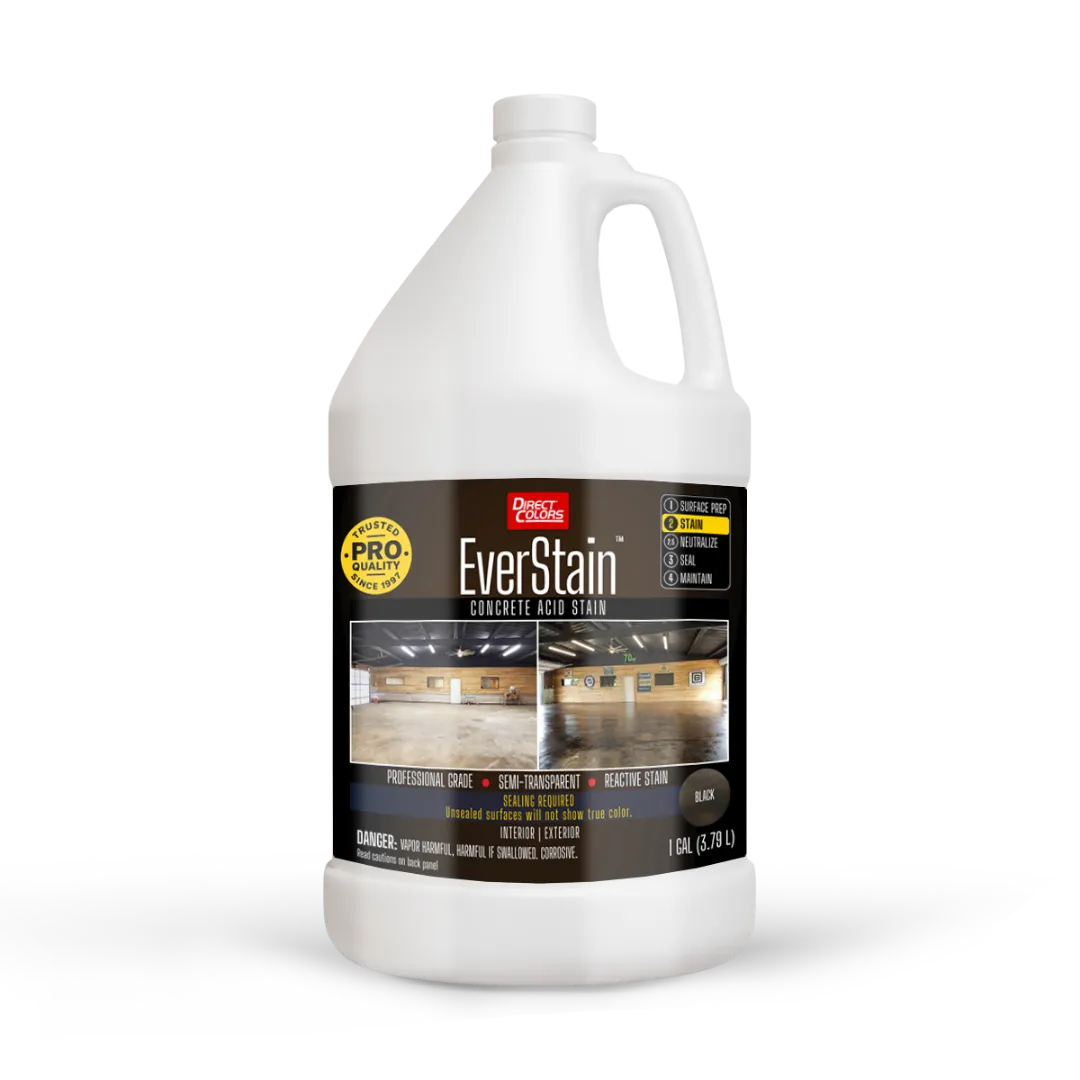
EverStain™ Acid Stain
How-to-Guide
Preliminary Testing
Before using the product for your entire project, try it out on a small, hidden area of the surface you'll be working on. This will let you see how it looks and if it's the right fit for your project.
1 . Pre-Application
Step 1: Clean: EverStain™ Acid Stain should be applied only on clean surfaces devoid of dust, dirt, oil, grease, paint, adhesive, sealers, curing compounds, efflorescence, chemical pollutants, rust, algae, and mildew, which could interfere with the chemical reaction. Acid washing is discouraged as it may alter the surface's reactivity. Clean the surface with an eco-friendly degreaser and ensure thorough rinsing with clean water to remove any residues.
Step 2: Cured: The concrete or overlay must be fully cured prior to application. For optimal results, it is advised that cement-based products undergo a curing period of at least 28 days. In instances where a curing compound is necessary for freshly placed concrete destined for staining, the use of an impregnating internal cure is recommended. Distinct from traditional curing agents, internal curing compounds do not create a film or membrane on the surface.
Primarily formulated for uncolored concrete, these internal cures do not disrupt the chemical staining reaction, unlike typical sodium silicate-based products. This eliminates the need for membrane removal during the preparatory phase, facilitating a smoother application process.
Step 3: Temperature: For optimal results, apply EverStain™ Acid Stain when temperatures are between 40°F (4°C) and 95°F (35°C).
Step 4: Sound: Apply only to cement-based products that are not flaking or spalling. The substrate must be structurally sound. For surfaces showing signs of delamination, employ diamond grinding, shot blasting, or similar mechanical methods for removal. For concrete, ensure the surface has a minimum strength of 2500 psi.
Step 5: Profiled: Perform an absorption test to check if the concrete is ready for staining. Pour water onto the concrete surface and wait for 3-5 minutes.
If the water is not absorbed, the surface will need to be cleaned and etched with CitrusEtch™ to open the pores of the concrete. Detailed instructions can be found in the CitrusEtch™ Technical Data Sheet.
Before

After

IMPORTANT: Use spiked shoes when etching. If shoe prints are etched onto the concrete surface, you will need to usea mechanical grinder to removethem.
Required Tools
Personal Safety: Always wear appropriate personal protective equipment as recommended in the Safety Data Sheet.

- ProClean Degreaser
- Pressure Washer
- Scrub Brush/ Broom
- Mop /Bucket
- Wet/DryVacuum
- Surface Protector/Tape

- Safety Gear
- Plastic Pump Sprayer
- Spiked Shoes
- CitrusEtch ConcreteEtcher
- ProClean Neutralizer
- Scrub Brush /Broom
- Mop /Bucket
- Wet/DryVacuum

- Safety Gear
- EverStain Acid Stain
- Pump Sprayer/Spray Bottle/ Foam Brush
- Spiked Shoes
- ProClean Neutralizer
- Scrub Brush/Broom
- Mop/Bucket
- Wet/DryVacuum

- Safety Gear
- AcquaSeal or EasySeal Concrete Sealer
- Plastic Pump Sprayer or 1/4' Nap Roller/Tray

- ProWax Polish Concrete Wax
- 1/4' Nap Roller/Tray

- Long-handled Deck Brush
- Pressure cleaner
2 . Preparation
IMPORTANT: EverStain will permanently change the color of your concrete. Onceapplied, it can't be undone.
- Area Preparation: Cover any surfaces you don't want to stain to avoid accidentalapplication
- Test in a Hidden Spot: Before starting your project, test the stain in an out-of-sight area to see how it reacts. This stain is permanent, so there's no going back.
- Avoid Tape: Don’t use tape on concrete surfaces before orafter staining,as it can affect how well thestain works.
3 . Application
Please Note: The color of the stain in the bottle will not reflect the final colorafter reacting with theconcrete.
For Large Projects
Applying
- Using the all-plastic pump sprayer, pump it at least 20- 30 times to create a fine mist and prevent drops. Then, apply the stain liberally and continuously in a circular motion over the surface. To avoid creating uniform patterns, spray in random circles. This technique helps prevent visual lines in the stain unless you specifically want thateffect.
- Consistently maintain a wet edge if you desire a more uniform application.
- Gradually extend the application to the outer edges during thereaction phase.
- After the reaction has stopped, use fresh material for any areas that have not been colored, blending into previously completed sections to avoid lap marks.
- Allow the stain to sit for a minimum of 5 hours to ensureadequatereaction time beforeany rinsing.
To check the result
- Test for depth of color by wetting the surface in several places with acloth dampened with water.
- The wet surface's appearance will closely resemble the final color if sealed with a high-gloss solvent-based sealer.
- Final results depend on the composition of the concrete.
- Concrete etching marks will not be concealed by acid staining.
- Proper surface preparation is essential for successful outcomes.
Don’t forget the sealer
- For a deeper color, apply additional coats after the first has fully reacted, ensuring a minimum wait time of five hours between applications.
- The final coat should dry for at least 5 hours, with dense or burnished surfaces requiring a minimum of 18 hours dry time.
- Choosing a water-based sealer or a solvent-based sealer with asatin finish will result in aless intensecolor.
- The depth of color decreases in the following order: solvent-based gloss > solvent-based satin > water-based gloss> water-based satin.
For Smaller Projects
- Test for uniformity and depth of color by wetting the surface with acloth dampened with water.
- For enhanced color depth within stencil designs or on treated surfaces, apply additional coats once the initial reaction has concluded. Maintain a minimum interval of five hours between each application to ensure proper reaction and absorption.
- Utilize a small foam applicator, or spray bottle for detailed work on small areas and stencil designs. These tools offer precision for intricate patterns and controlled stain application.
- After application, allow thestain to dwell on thesurface for at least 5 hours before proceeding with stencil removal, rinsing, or cleaning. This dwell time is essential for thechemical reaction to fully develop.
4. Neutralizing
- After drying, EverStain™ Acid Stain leaves a powdery residue. Remove this by neutralizing the surface with a commercial pH neutralizer like ProClean Neutralizer™, followed by thorough water flushing and stiff brush scrubbing.
- Rinse the surface with clean water to remove all neutralizer and residue. If you opt not to use our ProClean Neutralizer™ and choose another neutralizing method instead, be mindful that the rinse water could be slightly corrosive and capable of staining. This requires extra caution to protect unstained areas, those with different colors,and plant-lifezones.
- Ensure complete removal of salty colored residue and achieve proper surface neutralization and cleanup.
- Utilizea wet/dry vacuum to collect colored wastewater.
- Final rinsing should continue until the runoff is clear. A white rag test, coming away clean, indicates a properly cleaned surface.
- Collect and properly dispose of all residue water and rinse water,adhering to environmental regulations.
NOTE: Keep in mind, using ammonia will result in strong fumes, and baking soda requires additional cleanup timeto remove extra residue. We do not recommend this type of product for neutralizing concrete.
5 . Sealing
- Acid stained concrete must be sealed to preserve the colorand finish.
- Ensure the surface is clean and dry prior to sealing. Fans and blowers can be used to speed up the drying process.
- Sealing stained surfaces enhances their brilliance and depth of color.
- Epoxy and solvent-based sealers will produce a deep and brilliant look, whereas water-based sealers tend to givea moretoned-down appearance.
Additional Information
Coverage
Coverage
Estimated coverage is approximately 200 square feet (18.58 m²) per gallon. Actual coverage rates may diff er based on factors such as surface porosity, texture, the age and condition of the concrete, chosen application method, and prevailing environmental conditions.
Surface Protection and Maintenance
Surface Protection and Maintenance
● Periodically inspect the sealed surface for areas where the sealer may be thinning or showing signs of wear due to traffic. Reapply the sealer as needed, following the guidance provided in the appropriate Technical Data Sheet.
● If traces of efflorescence are present, they should be removed using a gentle cleaner before resealing or applying any maintenance products.
● For interior surfaces, the application of ProWax Polish™ is recommended as a sacrifi cial layer on top of the existing seal coat to enhance protection and appearance. Ensure you obtain and review the appropriate Technical Data Sheet and Safety Data Sheet prior to using this product.
Suitability Sample
Suitability Sample
Prior to application, prepare a sufficient number of test areas on the actual substrate to determine the aesthetic suitability of the product for its intended use.
Limitation & Precautions
Limitation & Precautions
● Job site conditions, base color, concrete mix and slump, curing methods, finishing practices, stain application, surface permeability, and the age/condition of concrete can all vary — and these differences may cause color variations in the final result.
● Acid stain won't hide imperfections or existing stains in the concrete. Instead, it will create a mottled look, with colors and effects that depend on the concrete's texture and composition.
● Older concrete may not absorb the stain as well as newer surfaces, which can affect color uniformity and intensity.
● The EverStain™ Color Chart shows standard colors on plain gray concrete. Since every concrete surface is different, actual results may not match the chart. Acid stain outcomes can be unpredictable.
● Product literature, photos, and color chips are meant to represent colors accurately, but actual results on concrete may differ significantly.
● Black and Coffee Brown are high-solids stains and should be applied in very thin layers. Two thin coats are recommended. Allow the longest possible drying time between coats — ideally 18 hours, with a minimum of 4 hours.
● Avocado, Azure Blue, and Seagrass are moisture-sensitive and can produce black, spotty effects. These colors are not recommended for slag concrete or areas with heavy water exposure. They are best suited for interior use only, on a well-drained sub-grade free from hydrostatic pressure. UV exposure may darken them over time. Allow at least 24 hours of drying before sealing so rinse moisture can fully evaporate. Follow the application instructions closely for best results.
● Hard-troweled concrete can be difficult to stain. Allow extra drying time between coats on these surfaces.
● Acid stain colors may fade over time, especially with prolonged sun exposure. Proper maintenance can help minimize or prevent fading.
● Avoid contact with metal objects — especially galvanized ones — as this can produce explosive hydrogen gas during the acid staining process.
Slip Resistance
Slip Resistance
● EverStain™ does not alter slip resistance. Slip resistance is determined by the chosen sealer. For enhanced slip resistance on exterior surfaces, integrate OxiGrip™ into the sealer. Ensure you obtain and review the appropriate Technical Data Sheet and Safety Data Sheet prior to using this product.
Disposal
Disposal
For the disposal of any unused product, please refer to your local environmental or hazardous waste management authority to ensure compliance with local regulations.
Shelf Life & Storage
Shelf Life & Storage
● This product should be used within one year of purchase for optimal effectiveness. For storage, keep the product indoors, in a cool area away from direct sunlight and heat sources.
Available Sizes & Packaging
Available Sizes & Packaging
- 4-Ounce(0.118L) Bottle
- 1-Gallon (3.785L) Jug
- 5-Gallon (18.925L) Carboy
Applicabe Standards
Applicabe Standards
Meets EQ Credit 4.2 for Low-Emitting Materials: Paints & Coatings, when applied in conjunction with a low VOC sealer.
Complementary Products
Complementary Products
● ProClean Degreaser™ Concentrate Cleaning agent.
● CitrusEtch™ - Concrete etching agent.
● ProClean Neutralizer™ Concentrate.
● EasySeal™ Acrylic Solvent-Based Sealer
● AcquaSeal™ Acrylic Water-Based Sealer
● OxiGrip™ Slip resistant Sealer additive
● ProWax Polish™ Premium Floor Wax
EverStain Resources


Get Inspired by Spaces

Shop this look


Shop this look


Shop this look

Shop this look


