
Liquid pigment is weighed, not poured by eye. It goes in with the batch water, the container gets rinsed into the mix so the whole dose is delivered, and the batch is mixed until the color is uniform. The one thing that catches people out is that there are two dose ladders, and which one you are on depends on the color — Carbon Black and Blue reach full color at roughly a third of the dose the other five need.
The two dose ladders
Each ladder is the range developed for those colors in the laboratory, and each step up is a deeper shade of the same color. Figures are pounds of paste per 94 lb sack of Portland cement.
| Step | Standard ladder — 101, 119, 204, 205, 206 | Lower ladder — 102, 201 |
|---|---|---|
| Step 1 | 1 lb per sack | 0.5 lb per sack |
| Step 2 | 3 lb per sack | 1 lb per sack |
| Step 3 | 5 lb per sack | 1.5 lb per sack |
| Step 4 | 7 lb per sack | 2 lb per sack |
- Step 1 — standard 1 lb per sack · lower 0.5 lb per sack
- Step 2 — standard 3 lb per sack · lower 1 lb per sack
- Step 3 — standard 5 lb per sack · lower 1.5 lb per sack
- Step 4 — standard 7 lb per sack · lower 2 lb per sack
Standard ladder: Red 101, Yellow 119, Chromium Green 204, White 205, Charcoal 206. Lower ladder: Carbon Black 102 and Blue 201. On a five-sack cubic yard multiply by five, so the standard ladder is 5, 15, 25 and 35 lb per yard and the lower ladder is 2.5, 5, 7.5 and 10 lb. As a percentage of cementitious weight the standard steps are 1.1%, 3.2%, 5.3% and 7.4%; the lower steps are 0.5%, 1.1%, 1.6% and 2.1%.
The lower ladder is not a restriction — it is the correct scale for those two colors. Dose Carbon Black or Blue on the standard ladder and you will overshoot.
The maximum is the top of your color’s own ladder — 7 lb per sack on the standard ladder, 2 lb per sack on the lower one. There is no single maximum for the liquid line, and the 10% pigment ceiling that applies to powder pigment does not carry across, because a paste dose is not a pigment loading. Above the top step there is no recommendation; call 405-275-6657 before going higher.
Weigh it — a volume is not a dose
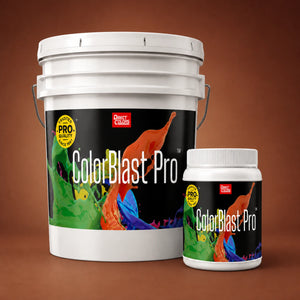
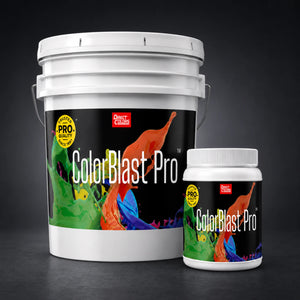
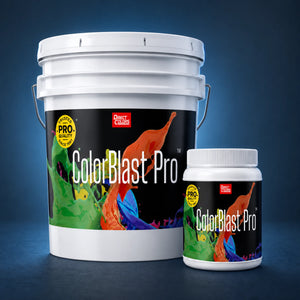
The paste is sold by net weight, in a 2 lb pack and a 44 lb pail, and weight is the only unit it is dosed in. The colors differ in density by roughly a factor of two, so the same volume of two colors is not the same dose. That density spread is also why a 44 lb pail is filled to weight rather than to the top — how full it looks varies from one color to the next, and that is not a short fill. Check the label, not the level.
Mixing it into the batch
- Weigh the dose. Never measure it by volume.
- Charge it with the batch water so the paste is carried through the mix. It goes into the batch, never onto the surface — this is not a dry-shake, a color hardener or a stain.
- Rinse the container into the batch. A high-concentration paste leaves a real dose behind on the walls of the pack, and what stays in the container is missing from the color.
- Mix until the color is uniform through the whole batch. Under-mixing is a common cause of streaking and mottling.
- Establish the mixing time on a trial batch and then hold it. Direct Colors publishes no mixing time for this line, so the time is whatever your trial batch shows is enough — and then it is the same time, the same mixer and the same sequence on every batch of the job.
- Account for the water the paste carries in. Where the mix design controls water closely, allow for it and confirm on the trial batch. There is no published water-equivalence figure for this line, so it is not something to calculate — it is something to measure on your own mix.
- Do not dilute it to make it easier to pour, and do not pre-mix it with anything other than the batch water.
Never blend it
Do not blend a paste with another paste, with a powder, or with any other colorant. This is the point where habits from the powder line cause trouble: powder codes can be blended to reach a shade between two published ones, and paste cannot. If the color you want is not one of the seven at one of the four steps, the answer is a conversation, not a blend.
A paste code is not the powder code with the same number
The paste codes are their own set. They are not the same colors, not the same chemistry in every case, and not the same doses, and no figure moves between the two lines in either direction. Paste 201 is Blue; the powder line numbers its blues differently, and the difference between them is one of hue rather than strength. Do not treat one as an alternative form of the other, and check that the pack and the order read the code you meant.
The chemistry does not track the number either. Red 101 and Yellow 119 are iron oxides; Carbon Black 102 is a carbon black, Blue 201 is an organic pigment, Chromium Green 204 is chromium oxide and White 205 is titanium dioxide. Two of the seven are blacks — 102 and 206 — and they are different products on different ladders, not substitutes.
Storage — the one that catches people out in winter
Store above 37 °F and do not let it freeze, in transit, in storage or on site. Bring deliveries indoors; do not leave paste in an unheated truck, a job box or an open yard in freezing weather. Material that has frozen is not to be used. The 37 °F figure carries a deliberate margin above freezing.
Unopened, the shelf life is six months from the date of purchase, so order for the work in hand rather than for stock and use the oldest material first. Once a pack is opened, close it again and use it promptly. Keep it in a cool, dry, well-ventilated place away from direct heat.
If a pack arrives frozen or partly frozen, contact Direct Colors within 24 hours of delivery with the order number and photographs. The window is short because after that it is not possible to establish whether the product froze in transit or after it was delivered. If a pack has stood for a long time, call before using it rather than assuming it can be stirred back — there is no published guidance on re-dispersing settled material.
Carbon Black 102, exterior work and air-entrained mixes
Carbon Black 102 is recommended for interior and protected applications, and for concrete that is not air-entrained. Carbon black is not recommended for air-entrained concrete, and exterior flatwork in freeze-thaw regions is normally specified with entrained air. For an exterior project, or any mix specifying entrained air, call 405-275-6657 before ordering. This applies to 102 specifically and is not a statement about Charcoal 206 or any other color here.
More broadly, no exterior-service data and no air-entrainment data is published for the liquid line at all. That is stated rather than left to inference: it is not a recommendation for such work and not a claim that the products are unsuitable for it. Exterior work, freeze-thaw exposure and any air-entrained mix want a conversation and a trial pour before the product is committed.
Approve the color from a cured panel
Make a test panel with the actual cement, aggregate, water, admixtures, dose and finishing method for the work, cured the way the work will be cured, and approve the color from the cured panel. If the work is exterior, expose the panel the way the work will be exposed. Color cards, printed swatches and screen renderings indicate a color; they do not predict it, and the cured panel in the project’s own materials is the only basis for approving color.
Gray Portland cement has its own color and mutes every pigment, so white Portland at the same color and step gives a different, cleaner result. White 205 is the special case — it has to overcome the gray of the cement rather than tint it, so it behaves differently from the other six across the ladder. Discuss 205 with Direct Colors before committing a dose. The 2 lb pack is the trial-batch and test-panel size.
What else moves the color
- Water content and water-cement ratio — the largest single cause of batch-to-batch variation. Do not add water after batching; it lightens and washes out the color and is not recoverable.
- Calcium chloride. Do not use it or any chloride-based accelerator — it causes mottling and discoloration in colored concrete.
- Curing. Even curing and even drying give even color.
- Sealers and surface treatments, which generally darken the apparent color, solvent-based sealers most of all.
- Efflorescence — a whitish deposit that arises from the concrete itself, more noticeable on colored concrete than on gray. It is not a defect of the pigment.
- Keep a consistent water-cement ratio and a 4 to 6 inch slump across the job, and hold the mix design, the materials and the methods constant throughout.
Common questions
How much liquid concrete pigment do I need per sack of cement?
That depends on the color, because there are two dose ladders. Red 101, Yellow 119, Chromium Green 204, White 205 and Charcoal 206 run 1, 3, 5 or 7 lb of paste per 94 lb sack. Carbon Black 102 and Blue 201 run 0.5, 1, 1.5 or 2 lb per sack, because they reach full color at a much lower dose. On a five-sack cubic yard, multiply by five.
Can I measure liquid pigment by volume instead of weighing it?
No. The paste is sold and dosed by net weight, and the colors differ in density by roughly a factor of two, so the same volume of two colors is not the same dose. Weigh it. For the same reason a 44 lb pail is filled to weight rather than to the top, so how full it looks varies from color to color.
Is paste code 201 the same as the powder with a similar number?
No. A paste code is not the powder code with the same number. They are different materials with different chemistry and different doses, and the difference between paste 201 Blue and powder 203 is one of hue, not merely of strength. No figure published for one applies to the other, in either direction. Check that the pack and the order read the code you intend.
Can I mix two liquid pigment colors together?
No. Do not blend a paste with another paste, with a powder, or with any other colorant. This is the opposite of the powder line, where codes can be blended, so do not carry the habit across.
What do I do if liquid pigment freezes?
Do not use it. Store the product above 37 degrees Fahrenheit and do not let it freeze in transit, in storage or on site. If a pack arrives frozen or partially frozen, contact Direct Colors within 24 hours of delivery with the order number and photographs. The window is short because after that it cannot be established whether the product froze before or after it was delivered.
Does the 10 percent pigment limit apply to liquid pigment?
No. That limit is a limit on pigment, and a paste dose is not a pigment loading, because paste is part pigment and part carrier. There is no single maximum for the liquid line. The maximum for each color is the top of its own ladder: 7 lb of paste per sack for Red 101, Yellow 119, Chromium Green 204, White 205 and Charcoal 206, and 2 lb per sack for Carbon Black 102 and Blue 201.
What’s Next
- On a tile line → Carbon Black Powder vs Paste for Tile Production
- Weight, not volume → Should Liquid Pigment Be Measured by Weight or Volume?
- Which black → Carbon Black 102 vs Charcoal 206
- Production batching → Weighing vs Pumping Liquid Pigment
- Paste and water → Does Liquid Pigment Change the Water-Cement Ratio?
- When it goes wrong → Concrete Pigment Troubleshooting: Streaks, Speckles and Uneven Color
- Working out quantities → How Much Liquid Concrete Pigment per Cement Sack or Cubic Yard?
- Approve the color first → How to Make and Approve a Concrete Pigment Test Panel
- The powder line → How to Mix Concrete Pigment Powder Without Streaks
- The fundamentals → Integral Color Concrete
- Ready-mix quantities → How Much Pigment for a Concrete Truck Pour
- Mortar, grout and stucco → Custom Mortar Colors · Colored Grout · Stucco Colors
- Shop → ColorBlast Pro™ Pigment Paste
- Questions → call Direct Colors on 405-275-6657
Direct Colors. Shawnee, OK. Manufacturing the full decorative concrete system since 1997.


