
Streaked pigment is almost always one mistake: the powder went in with the water instead of before it, or it was not blended long enough. Pigment goes into the dry material first, gets three to five minutes of blending, and sits in the mix at least 20 minutes before the pour. Do that and the color comes out even in a five-gallon bucket or a mortar mixer alike. This is how to mix it properly, by equipment.
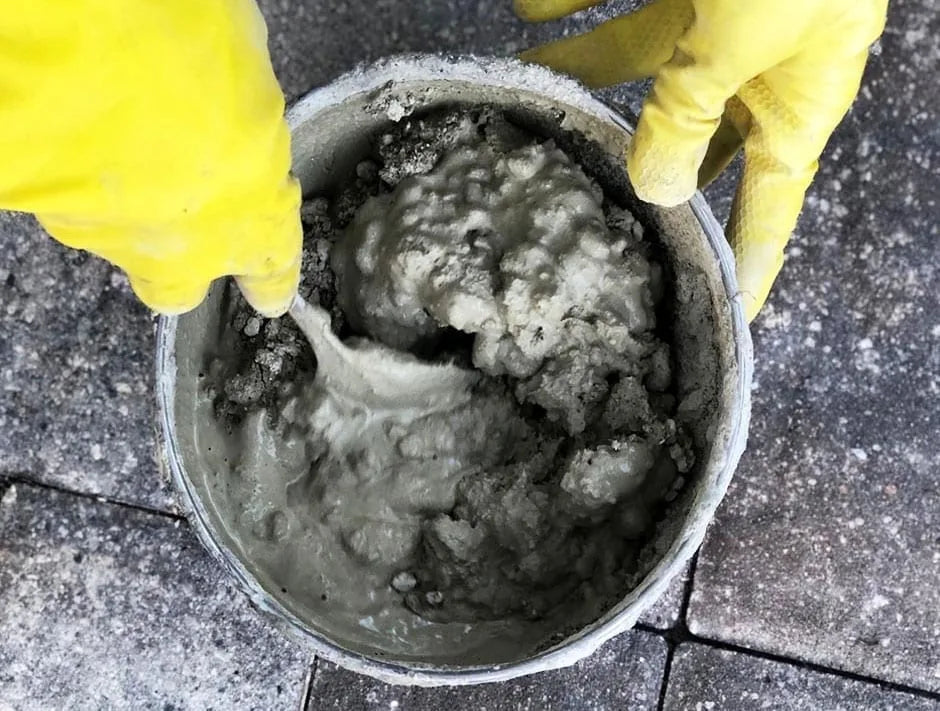
Pigment blended into the dry mix before any water goes in.
How much pigment, before you mix anything
Dose is calculated on the weight of the cement and lime in the mix. Nothing else takes color — not the sand, not the aggregate — so it is never worked out on the weight of the whole bag, and never on the volume of the pour. Each Direct Colors shade name is a base code plus a dose step in pounds per 94 lb sack of cement, so choosing the shade chooses the dose. Run your numbers through the pigment calculator, and for ready-mix quantities see how much pigment a truck pour needs.
Do not exceed 10% of cementitious weight — 9.4 lb per 94 lb sack. Loading above that can affect strength, set time and finish.
Weigh it — do not scoop it
Because the dose is a percentage of weight, a volume measure cannot express it. Bulk density also varies from one code to the next, so a level scoop of one color is a different dose from a level scoop of another. Use a scale. On a full sack the step is a round number of pounds; on small craft batches you are weighing ounces, so use a scale that reads to a tenth of an ounce.
Bucket and drill — small batches and craft work
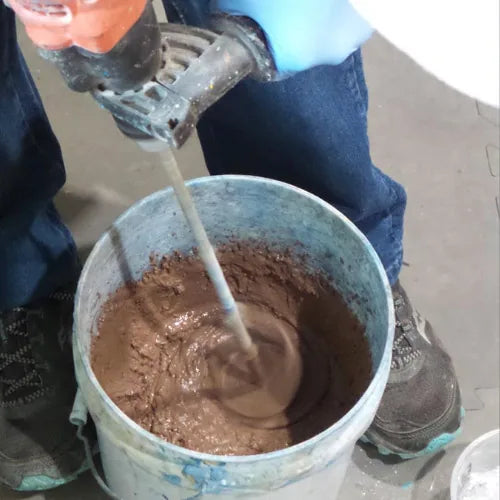
A five-gallon bucket mixed with a bird-cage paddle on a drill motor.
- Dry material into the bucket first — cement, or your dry mix.
- Add the weighed pigment on top of the dry material. No water yet.
- Blend three to five minutes with a bird-cage paddle on a drill motor, until the color is completely uniform and there are no darker or lighter patches left.
- Then add water, following the water ratio on the bag. On a small pour it is easy to go wet, and wet concrete is weak concrete.
- Let it stand. Get the pigment into the mix at least 20 minutes before you pour — that dwell time is what gets you even color instead of streaks.
Mortar and paddle mixers
Same order, bigger machine. Combine the pigment and the dry material in the mixer before adding water — that single step is what determines whether the color comes out even. Let it turn until the color is uniform through the whole charge before the water goes in. For mortar and stucco, remember the dose is worked out on the cement and lime only; see custom mortar colors and stucco colors.
Portable drum mixers
A tow-behind or electric drum is site mixing. Charge the pigment with the cement and aggregate before the full water charge, then run 10 to 12 minutes after all the materials are in. Treat that as a starting point rather than a specification — mixing time depends on the mix design and on your own established practice, and the test to satisfy is uniform color, not the clock.
At the plant
Ready-mix is charged and timed differently again, and the numbers there are revolutions rather than minutes. That is covered in full in how much pigment a truck pour needs.
What actually causes streaks
- Under-mixing. The most common cause of streaking and mottling, by a distance.
- Pigment added after the water. It will not disperse evenly, and it will not blend out later.
- Water added after batching. It lightens and washes out the color, and the effect is not recoverable.
- Batches mixed differently. Same pigment, same mix, same water, same mixing time, every batch — or the pieces will not match.
- Calcium chloride. Do not use it, or any chloride-based accelerator. It causes mottling and discoloration in colored concrete.
- Uneven curing. Color follows the cure. Where a slab dries evenly, it colors evenly.
Blending two colors
Powder codes can be blended to reach a shade between two of the published ones. The important arithmetic is that the 10% ceiling applies to the total pigment from every code combined, not to each code separately — two colors at 5 lb per sack each is 10 lb per sack and over the limit. Write the recipe down by weight, and approve it from a cured panel before you commit a batch.
Handling the powder
From the product safety data sheet: wear a dust-protection mask, suitable protective clothing, gloves and footwear, and — if contact with the product is possible — safety glasses with side shields. Use only with adequate ventilation; where the work generates dust, use process enclosures or local exhaust ventilation. Wash hands, forearms and face after handling, and wash contaminated clothing before it is worn again.
Approve the color from a cured panel
Color cards and screen renderings indicate a color; they do not predict it. Make a test panel with the actual cement, aggregate, water and finishing method for the job, cure it the way the work will be cured, and approve the color from the cured panel. Every shade Direct Colors publishes is rendered on gray Portland cement — white Portland at the same code and dose reads cleaner and more saturated, so decide which cement the job uses before choosing a shade. A pigment sampler is the cheap way to do this before committing a batch.
Common questions
How long should I blend pigment into the dry mix?
Three to five minutes, and get the pigment into the mix at least 20 minutes before you pour. That dwell time is what gets you even color instead of streaks. Blend until the color is completely uniform with no darker or lighter patches, then add water.
Do I mix concrete pigment wet or dry?
Dry. Combine the pigment with the cement and the dry material before any water goes in. That single step is what determines whether the color comes out even. Pigment added to an already-wet batch streaks, and the streaks do not blend out.
Can I measure pigment with a scoop instead of a scale?
No. Dose is a percentage of cementitious weight and is never calculated on volume, and bulk density varies from one pigment code to the next, so a scoop of one color is not the same dose as a scoop of another. Weigh it.
Can I add water if the batch is too stiff?
No. Water added after batching lightens and washes out the color and the effect is not recoverable, and color cannot be corrected after placement. Set the water at the start. If a small batch comes out unworkable, discard it and rebatch rather than trying to save it.
Can I mix two pigment colors together?
Yes, powder codes can be blended. The 10% ceiling applies to the total pigment from every code combined, not to each code separately, so two colors at 5 lb per sack each is 10 lb and over the limit. Sample the blend on a cured panel before committing, and write the recipe down by weight.
How much pigment does a bag of pre-mixed concrete need?
Direct Colors does not publish a dose for third-party bagged concrete mix, because dose is calculated on the weight of cement and lime and that figure is not printed on the bag. Batch from separate cement, sand and aggregate so you know the cement weight you are dosing against.
What’s Next
- Gray or white cement → White Cement vs Gray Cement: How the Base Changes Pigment Color
- Why more is not darker → Why More Concrete Pigment Is Not Always Better
- Chemistry by code → Concrete Pigment Chemistry Explained
- Specifying it → How to Specify Concrete Pigment Under ASTM C979
- A shade between two → How to Develop a Custom Shade
- When it goes wrong → Concrete Pigment Troubleshooting: Streaks, Speckles and Uneven Color
- Working out quantities → How Much Concrete Pigment Powder per Cement Sack or Bag?
- Approve the color first → How to Make and Approve a Concrete Pigment Test Panel
- The fundamentals → Integral Color Concrete
- Using the liquid instead → How to Use Liquid Concrete Pigment
- Work out quantities → Pigment Calculator
- Ready-mix quantities → How Much Pigment for a Concrete Truck Pour
- Mortar, grout and stucco → Custom Mortar Colors · Colored Grout · Stucco Colors
- Craft and cast pieces → DIY Concrete Craft Projects
- Test first → Pigment Sampler
- Shop → Concrete Powder Pigment
Direct Colors. Shawnee, OK. Manufacturing the full decorative concrete system since 1997.


