
Pigment for a truck pour is dosed on the weight of cementitious material in the mix, not on the volume of the pour. On a standard five-sack yard that comes to 5, 15, 25 or 35 lb of pigment per cubic yard depending on how deep you want the color. Order it wrong and you have a driveway in the wrong color, because it cannot be corrected after placement. This is how to get it right before the truck leaves the plant.
Prefer to listen? Shawna Turner covered mix design, additives, trowel finish and protecting a new slab. The player is at the end of this article.
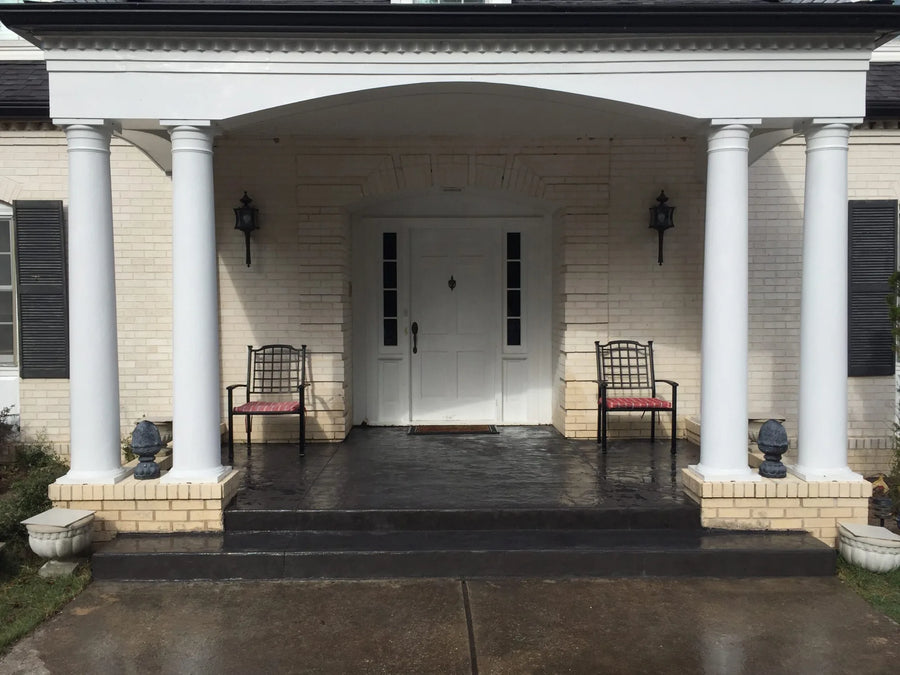
A stamped front porch poured in gray integral color.
How much pigment per cubic yard
Every Direct Colors shade name is a base color plus a dose step, and the step is the dose in pounds of pigment per 94 lb sack of cement. Smokestack is code 102 at 5 lb per sack, which is why it is written 102-5. Pick the shade and you have picked the dose.
| Shade step | lb per 94 lb sack | lb per cubic yard, five-sack mix |
|---|---|---|
| Step 1 | 1 lb | 5 lb |
| Step 3 | 3 lb | 15 lb |
| Step 5 | 5 lb | 25 lb |
| Step 7 | 7 lb | 35 lb |
| Maximum | 9.4 lb | 47 lb |
- Step 1 — 1 lb per 94 lb sack · 5 lb per cubic yard · light tints and pastels
- Step 3 — 3 lb per 94 lb sack · 15 lb per cubic yard · mid-tone
- Step 5 — 5 lb per 94 lb sack · 25 lb per cubic yard · saturated color
- Step 7 — 7 lb per 94 lb sack · 35 lb per cubic yard · deep and near-black tones
- Maximum — 9.4 lb per 94 lb sack · 47 lb per cubic yard · do not exceed
As a percentage of cementitious weight those steps are 1.1%, 3.2%, 5.3% and 7.4%, and the ceiling is 10%. The cubic-yard column assumes a five-sack mix — 470 lb of cementitious material per yard. If your supplier is running anything else, dose on the cementitious weight of that mix and ignore the yardage entirely. Do not go above 10%. Loading above that can affect strength, set time and finish.
Step 1 — get the cementitious weight, not just the psi
Ask the ready-mix company for the sack count, or the pounds of cementitious material per cubic yard. That figure is what the dose is calculated against. Most residential slabs are 3000 or 3500 psi and psi is a rough proxy for cement content — the higher the psi, the more cement there is to color, and the more pigment the same shade needs — but psi is not the number you dose on. Get the sack count. The calculator covers 3000–6000 psi.
Step 2 — ask about fly ash
Suppliers substitute fly ash for cement at rates commonly between 15% and 40%. Two things follow from that, and they pull in opposite directions. Fly ash and slag count toward the cementitious weight, so they belong in the dose calculation — leave them out and you under-dose the load. But they also lighten the finished slab and make the color less predictable. Ask for a mix at around 10% fly ash, and no more than 20%.
Step 3 — calculate by the yard
The number of yards decides the pounds of pigment. Run it through the pigment calculator against the shade you want. If more than one truck is involved, the same pigment load and the same water go into each — otherwise the loads will not match and the joint will show forever.
Step 4 — have the plant add it
Pigment is batched into the mix with the aggregate and cement, before the full water charge, so it disperses through the dry materials. It is not a dry-shake and it is never broadcast onto a finished surface.
Four things that ruin a colored pour
- Calcium chloride. Do not use it, or any chloride-based accelerator. It causes mottling and discoloration in colored concrete. Ask for the mix design in writing and check.
- Water added after batching. This is the one to watch on site. Water has a substantial effect on final color, and adding it lightens and washes out the result — the effect is not recoverable. Hold a consistent water-cement ratio and a 4–6 inch slump across the whole job.
- Uneven curing. Color follows the cure. Where a slab dries evenly it colors evenly, so protect it from patchy sun, wind and standing water.
- Assuming it can be fixed later. Color cannot be corrected after placement. Every variable you hold constant from load to load is one that cannot move the color.
Approve the color before the truck is booked
Color cards, screen renderings and samples made with other materials indicate a color. They do not predict it. Make a test panel using the actual cement, aggregate, water and finishing method for the job, cure it the way the slab will be cured, and approve the color from the cured panel. Every shade rendering Direct Colors publishes is produced on gray Portland cement; white Portland at the same code and dose reads cleaner and more saturated, so state which cement the work will use before choosing a shade.
Send the cement and sand intended for the work and the Direct Colors color lab will work up a match against your materials.
Common questions
What should I ask the ready-mix company before the pour?
Ask for the mix design details, and do it before the truck is booked. You want no retarders, no accelerators, and no more than 10% fly ash — none of which are essential; they get used for hot or cold weather and, in fly ash's case, to cut cost. Also avoid a topical curing compound unless it self-dissipates and evaporates within about two weeks. Either you or your contractor can make that call.
What concrete finish takes acid stain best?
Hand-troweled, or lightly machine-troweled. The goal is to stop short of the glassy finish a hard machine trowel produces — if the surface is closed, the stain cannot absorb, the reaction never happens, and the color simply washes off during cleaning. Stamped or textured is fine outdoors. If a slab does come back too smooth, CitrusEtch™ can open it after the fact.
How long should new concrete cure before acid staining?
Until it is fully cured and has gone a uniform light gray — typically 20 to 28 days, depending on the weather. The color change is the signal to watch for rather than the calendar alone. Protect the slab for that whole period with overlapping cardboard, which cushions impacts and absorbs spills.
How do I protect the floor for the rest of the build?
Overlapping cardboard, and a conscientious contractor — the second matters more. Cover the slab from the pour onward, and after the first coat of sealer let it harden before re-covering; the two episodes on this differ (six hours versus ten), so allow the longer. Then just before baseboards go in, uncover, clean, apply the second sealer coat, and 24–48 hours later apply three coats of wax, drying 24 hours before furniture.
How much pigment goes into a cubic yard of concrete?
Dose is set per 94 lb sack of cement and then multiplied by the number of sacks in the mix. On a standard five-sack yard, which is 470 lb of cementitious material, the four published steps work out to 5, 15, 25 and 35 lb of pigment per cubic yard. The ceiling is 10% of cementitious weight, or 47 lb per yard. If the mix is not a five-sack design, dose against its actual cementitious weight rather than the yardage.
Can the driver add water to the load on site?
No. Water added after batching lightens and washes out the color, and the effect is not recoverable. Set the water at the plant, hold the same water-cement ratio and a 4 to 6 inch slump across every truck on the job, and turn away a load that has been retempered.
Listen to this episode
Direct Colors DIY Home Improvement · Episode 18
Tips for Pouring Acid Stain Ready Concrete
Amie Nolen and Shawna Turner · 5 min 46 sec · read the full transcript
What’s Next
- When it goes wrong → Concrete Pigment Troubleshooting: Streaks, Speckles and Uneven Color
- Working out quantities → How Much Concrete Pigment Powder per Cement Sack or Bag?
- Approve the color first → How to Make and Approve a Concrete Pigment Test Panel
- The fundamentals → Integral Color Concrete
- Mixing it evenly → How to Mix Concrete Pigment Powder Without Streaks
- Every shade and its dose step → Concrete Pigment Color Chart
- Test first → Pigment Sampler
- Other surfaces → Cement, Stucco, Grout and Overlays
- Choosing a sealer → The Best Concrete Sealer
- Applying stain outdoors → How to Apply Outdoor Concrete Stain
- Prefer a reactive, mottled look? → Acid Stain Colors Guide
- Shop → Concrete Powder Pigment · Pigment Calculator
Direct Colors. Shawnee, OK. Manufacturing the full decorative concrete system since 1997.


