
How long you leave acid stain on concrete is one of the most important — and most overlooked — steps in the whole project. Leave it on too little and the color stays weak; leave it on too long and the natural marbling flattens into a solid, muddy tone. This is the acid-stain activation time: how long the stain reacts with the slab before you neutralize. Different colors react at different speeds, and as the stain works in, a light chalky residue forms (completely normal). The color table below lists the recommended times for the EverStain™ line.
Prefer to listen? Shawna Turner explained how to match two slabs poured at different times. The player is at the end of this article.
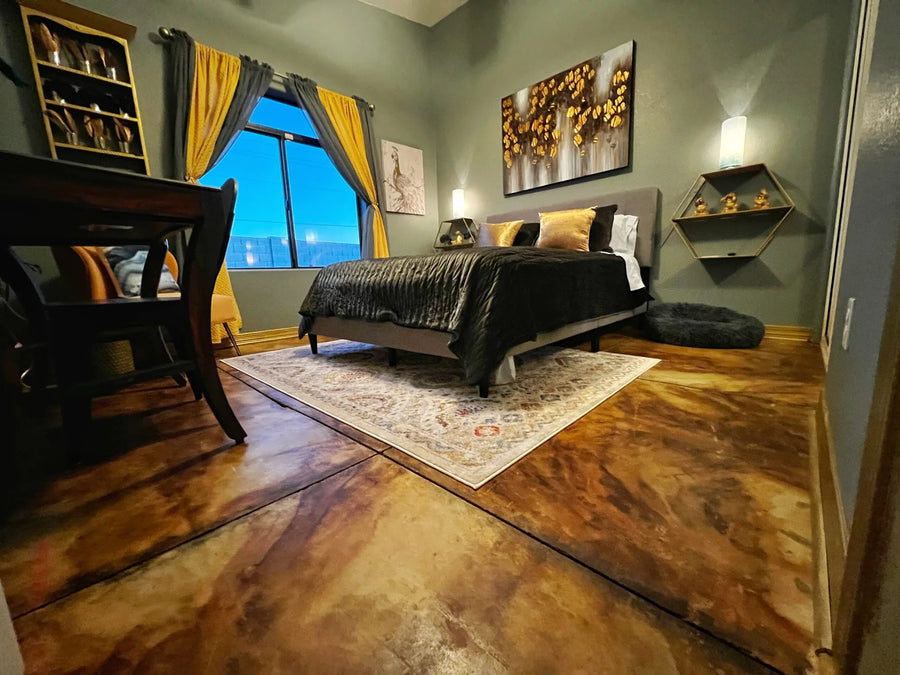
Azure Blue, Desert Amber, and Shifting Sand EverStain™ — the variegated, marbled look you get when each color is activated fully.
How long do you leave acid stain on concrete?
Leave acid stain on for a minimum of 4 to 8 hours depending on the color, up to a recommended maximum of about 12 hours for the deepest, most marbled result — then neutralize to stop the reaction. Never leave acid stain on beyond roughly 24 hours: past that point the color can overdevelop into a flat, solid tone instead of natural variegation. Warmer temperatures speed the reaction; cooler slabs take longer. The exact minimum for each EverStain™ color is in the table below.
EverStain™ acid stain activation times by color
| Color | First appears | Final color | Min. time | Max. time |
|---|---|---|---|---|
| Avocado | Greenish brown | Bluish green with brown accents | 4–6 hrs | 12 hrs |
| Azure Blue | Light blue | Medium blue | 4–6 hrs | 12 hrs |
| Black | Dark brown | Dark Brown to black | 4–6 hrs | 12 hrs (for darkest black) |
| Coffee Brown | Greenish brown | Medium to dark brown | 4–6 hrs | 12 hrs |
| Cola | Greenish brown | Reddish brown with warm orange tones | 4–6 hrs | 12 hrs |
| Desert Amber | Greenish brown | Straw with warm orange tones | 8 hrs | 12 hrs |
| English Red | Greenish brown | Reddish brown | 4–6 hrs | 12 hrs |
| Malayan Buff | Greenish brown | Golden tan with warm orange tones | 8 hrs | 12 hrs |
| Seagrass | Greenish brown | Sea foam with dark brown accents | 4–6 hrs | 12 hrs |
| Shifting Sand | Greenish brown | Olive green with reddish brown accents | 4–6 hrs | 12 hrs |
- Avocado — 4–6 hrs min (12 hrs max). Starts greenish brown, finishes bluish green with brown accents.
- Azure Blue — 4–6 hrs min (12 hrs max). Starts light blue, finishes medium blue.
- Black — 4–6 hrs min (12 hrs for darkest black). Starts dark brown, finishes black.
- Coffee Brown — 4–6 hrs min (12 hrs max). Starts greenish brown, finishes medium to dark brown.
- Cola — 4–6 hrs min (12 hrs max). Starts greenish brown, finishes reddish brown with warm orange tones.
- Desert Amber — 8 hrs min (12 hrs max). Starts greenish brown, finishes straw with warm orange tones.
- English Red — 4–6 hrs min (12 hrs max). Starts greenish brown, finishes reddish brown.
- Malayan Buff — 8 hrs min (12 hrs max). Starts greenish brown, finishes golden tan with warm orange tones.
- Seagrass — 4–6 hrs min (12 hrs max). Starts greenish brown, finishes sea foam with dark brown accents.
- Shifting Sand — 4–6 hrs min (12 hrs max). Starts greenish brown, finishes olive green with reddish brown accents.
These are minimums for Direct Colors EverStain™ acid stains. Because no two slabs are alike, you’ll see natural variation in depth and vibrancy — that’s what makes every acid-stained surface one of a kind. When in doubt, test a hidden spot first.
Acid Stain Activation Times: FAQs
How long do you leave acid stain on concrete?
A minimum of 4 to 8 hours depending on the color, up to a recommended maximum of about 12 hours for the deepest marbled result — then neutralize. Don’t leave it on beyond roughly 24 hours, or the color can overdevelop into a flat, solid tone.
Does acid stain react faster in warm weather?
Yes. Warmth speeds the chemical reaction, so a hot slab develops color faster, while a cold slab takes longer. In cool conditions, give it extra time and check the color with a water test before neutralizing.
Is acid stain permanent?
Yes. Unlike surface coatings, acid stain chemically bonds to the concrete, so it won’t chip, flake, or peel — even in high-traffic areas. EverStain™ resists foot traffic, moisture, and UV.
Why does my acid stain look chalky and dull during activation?
That’s normal. The chalky look is alkali-and-mineral residue from the reaction. Give the stain at least 4–6 hours, then neutralize and seal to make the true color pop.
Why do I have to neutralize?
Neutralizing is the “stop button” for the reaction. If you don’t neutralize, or you leave the stain on past the recommended window, the color keeps developing and can overdevelop into a flat, unnatural tone. See how to neutralize concrete acid stain.
How do I preview the final color?
After at least 4–6 hours, splash a little plain water on the stain — the wet color previews the sealed result. Sealing adds even more depth and vibrancy.
What if the color came out too light, uneven, or too intense?
Too light will deepen after sealing (and you can overlay pre-sealed stain with ColorWave® for more depth). Uneven is part of acid stain’s organic character. Too intense usually means it sat too long before neutralizing — since acid stain is permanent, correct it with a topical overlay like Vibrance™ dye, or sand back to bare concrete and redo it.
Why won't two slabs poured at different times stain the same?
Because acid stain reacts rather than coats. It depends on the minerals in the concrete surface, and concrete is never mixed identically twice — mineral content varies substantially batch to batch. Add a machine-troweled section, or years of weather eroding the surface minerals on the older slab, and the same stain applied the same way gives you two different colors.
How do I match a new slab to an older one?
Stain the older slab first, and give it time — up to 10 hours of processing for maximum color development, because weathered concrete needs longer to reach its best color. Neutralize and rinse so you can see the real color. Then stain the newer slab, start checking at 2–3 hours, and extend in one-hour steps until it matches. Compare both wet, using a spray bottle; dry acid-stained concrete tells you almost nothing about the sealed result.
How do I handle a concrete patch so it doesn't stand out?
Sand it flush, then stain it last. Do the rest of the floor first — stain and neutralize it — and leave the patch until afterwards, so you can control its activation time and creep up on a match. Mist both patch and floor with a spray bottle to judge it, and neutralize the patch the moment the wet colors agree. Getting the profile identical across the whole slab beforehand matters just as much.
What if I can't get a color match at all?
Switch to a topical product to blend it. Antiquing™ is the usual answer outdoors — it works as a stand-alone stain or as an accent over acid stain, and it is what customers use to even out repaired areas on an already-stained slab. Indoors, Vibrance™ dye can accent difficult spots. Either way it beats tearing out and starting again.
Listen to this episode
Direct Colors DIY Home Improvement · Episode 27
Acid Staining Side-by-Side Slabs Poured at Different Times
Tommy Carter and Shawna Turner · 6 min 19 sec · read the full transcript
What’s Next
- The full method → How to Acid Stain Concrete
- Neutralizing → How to Neutralize Concrete Acid Stain
- Blending colors → Layering Acid Stains
- Shop → EverStain™ Acid Stains · Trial Kits
Direct Colors. Shawnee, OK. Manufacturing the full decorative concrete system since 1997.


