
Most sealer failures are recoverable. A milky white finish, a peeling edge, a hazy floor. Almost none of these mean the slab is ruined. They mean the sealer needs to be re-flashed, stripped, or sometimes both. This guide walks through how to diagnose what went wrong, which fixes work for which failure, and when to strip and reapply.
Same framework whether the slab is a stained patio, a basement floor, a garage, or a poured driveway.
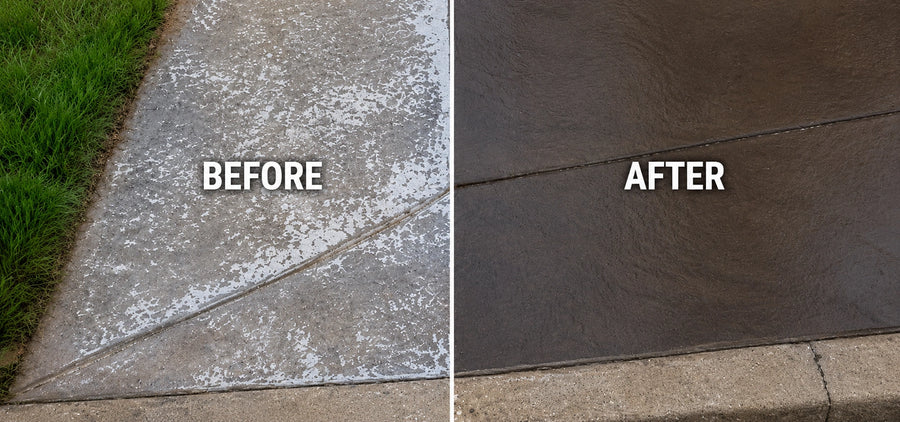
Most sealer failures are recoverable. The slab on the left can be brought back to the slab on the right with the right fix.
If you are a professional contractor go to the Pro's Sealer Playbook →
First, diagnose what went wrong
Match what you see on the slab to the most likely cause before you grab a product. The wrong fix on the wrong failure makes things worse.
Find your failure in the left column, then click the kind of sealer you used to jump straight to the fix.
| What you see | Most likely cause |
What kind of sealer did you use? Solvent Based (SB) or Water Based (WB) |
|---|---|---|
| Milky white or hazy |
|
SBWB |
| Peeling or flaking |
|
SBWB |
| Yellowing |
|
SBWB |
| Bubbles or blisters |
|
SBWB |
| Sticky or tacky finish |
|
SBWB |
| Cloudy with no clear cause |
|
SBWB |
-
Milky white or hazy. Likely cause: trapped moisture or dew point violation.
SBWB -
Peeling or flaking. Likely cause: adhesion failure from skipped etch, contamination, or sealing over residue.
SBWB -
Yellowing. Likely cause: UV degradation of older solvent acrylic.
SBWB -
Bubbles or blisters. Likely cause: moisture vapor pushing through the film or coats applied too thick.
SBWB -
Sticky or tacky finish. Likely cause: under-cured or wrong chemistry.
SBWB -
Cloudy with no clear cause. Likely cause: residual acid from skipped neutralizer step.
SBWB
Milky white or hazy sealer
This is the most common failure call Direct Colors gets. Almost always trapped moisture: either the slab was damp when you sealed, or condensation formed under the film during cure. The 5°F dew point rule (see Step 2 of the application guide) ruins more sealer jobs than anything else.
The fix depends on the chemistry of the failed sealer.
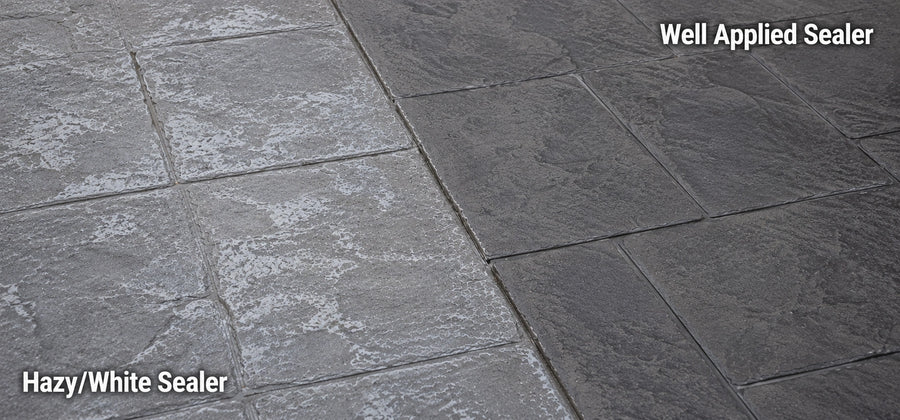
Milky haze on the failed side is trapped moisture under the film. The clear side shows what a properly applied sealer looks like.
Solvent-based sealers (EasySeal™ or EasyTint™)
EasyRepair™ is a solvent that re-flashes a cured solvent sealer. It dissolves the film, releases the trapped moisture, and lets the sealer re-flow and re-cure clear.
How to re-flash:
- 1. Confirm the slab is dry now. If moisture is still present, the milkiness will return as soon as the re-flashed sealer cures.
- 2. Apply EasyRepair™ to the affected area with a brush or solvent-resistant pump sprayer.
- 3. Work it into the film with light back-rolling using a solvent-resistant 3/8" nap roller. The sealer transitions from milky to clear within a few minutes as it re-dissolves.
- 4. Let it re-cure 24 hours before traffic.
Critical warning: EasyRepair™ only works on solvent-based sealers (EasySeal™ and EasyTint™). Using it on water-based sealers (HydroCryl™, AcquaSeal™, AcquaTint™) will destroy the finish.
Water-based sealers (HydroCryl™ or AcquaSeal™)
There's no re-flash equivalent for water-based sealers. Water-based acrylics cure by water evaporation and chemical cross-linking; once that cross-link is set, you can't re-dissolve and re-flow it. The fix is strip and reapply.
- 1. Strip the affected area with Destiny Stripper™ (see the strip section below).
- 2. Diagnose the moisture issue before resealing. If the slab is still damp, the new sealer will fail the same way. Run the plastic sheet test or check the dew point margin before reapplying.
- 3. If moisture keeps coming back, use ProSeal Li™ as a base coat. ProSeal Li™ is a penetrating sealer that has no film to peel or turn white. Topcoat with HydroCryl™ once the ProSeal Li™ has cured.
- 4. Reapply the sealer following the proper application steps (see the application guide).
Peeling or flaking sealer
Sealer that peels in sheets within a year of application is an adhesion failure. The sealer didn't bond properly to the concrete. The most common causes:
- The slab wasn't etched, so the sealer had nothing to grip
- The slab wasn't neutralized after etching, so residual acid blocked the bond
- The slab was contaminated with oil, old sealer residue, curing compound, or efflorescence
- The slab was damp at application
- An incompatible sealer was layered over a different chemistry
Peeling sealer cannot be re-flashed. The bond is broken and re-dissolving the film won't restore it. The fix is strip and re-prep.
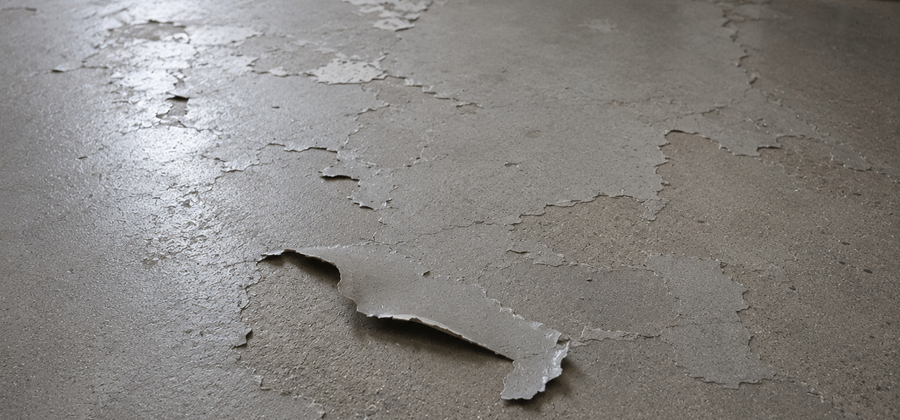
Peeling and flaking are adhesion failures. The bond is broken. Re-flashing won't restore it. Strip and re-prep is the only fix.
- 1. Strip the entire affected area, plus any soft edges around it where the sealer is starting to lift. Don't try to feather a new coat into a peeling edge. It'll fail at the seam.
- 2. Re-prep the slab with the full CLEAN → ETCH → NEUTRALIZE → RINSE sequence. This is where the original job failed. Don't skip a step this time.
- 3. Confirm the slab is dry and the dew point margin is met.
- 4. Reapply the sealer following the proper application steps.
Yellowing
Older solvent-based acrylic sealers can yellow over time from UV exposure. The slab itself is fine, but the sealer film has chemically degraded.
If yellowing is mild and the underlying stain still looks good, you can sometimes re-flash with EasyRepair™ and apply a fresh top coat to mask the discoloration. For severe yellowing, the only fix is strip and replace with a UV-stable sealer.
All current Direct Colors sealers (HydroCryl™, EasySeal™, AcquaSeal™, and ProSeal Li™) are UV-stable. If you're replacing a yellowed sealer, any of these will hold their color long term.
Bubbles, blisters, or sticky finish
Two related failures, different causes.
Bubbles and blisters. Moisture vapor pushed up through the film as it cured. The slab has higher moisture than the dew point rule allows, or the sealer was applied too thick and trapped solvent or water under the surface skin.
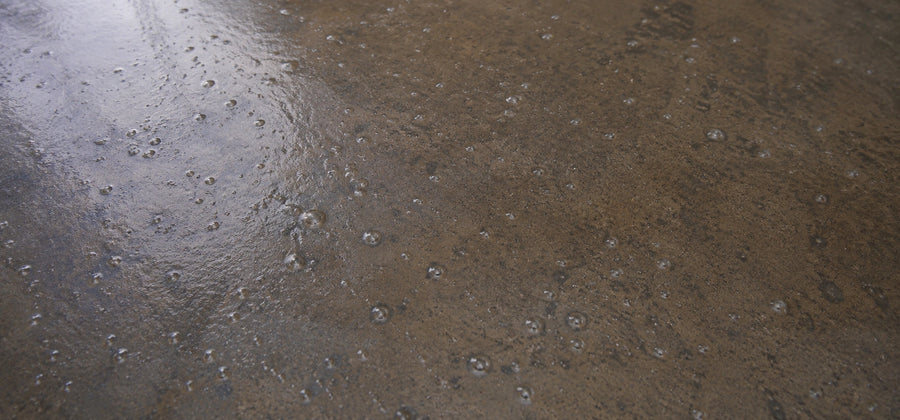
Bubbles and blisters form when moisture vapor or trapped solvent pushes up through the curing sealer film.
Sticky or tacky finish. Most often under-cured. Wait the full cure time before declaring it a failure. Solvent sealers can take 7 days to fully cure in cool, humid weather. If it's still tacky after 7 days at room temperature, the sealer is wrong for the conditions or got contaminated, and needs to be stripped.
For both failures: identify the root cause first (moisture, wrong chemistry, thick coats), strip the failed area, fix the underlying issue, and reapply correctly.
If the bubbles are pinholes rather than blisters and the rest of the finish is solid, you can sometimes re-flash a solvent sealer with EasyRepair™ to re-melt the surface and seal the pinholes. This doesn't fix underlying moisture issues.
How to strip a failed sealer
When re-flashing isn't an option, stripping is. Two approaches depending on what you're removing.
Destiny Stripper™
Destiny Stripper™ is our heavy-duty coating remover for stubborn water-based sealers (HydroCryl™ and AcquaSeal™ in particular), plus thick or multi-layer film build-up from past recoats.
1. Test first.
- Run Destiny Stripper™ on a small hidden area before doing the whole slab.
- Confirms it works on your specific coating.
- Dials in dwell time and gives you a coverage estimate.
- Coverage: 100–150 sq ft per gallon.
- Multi-layer build-up from sealers and stains drops coverage and may need more applications.
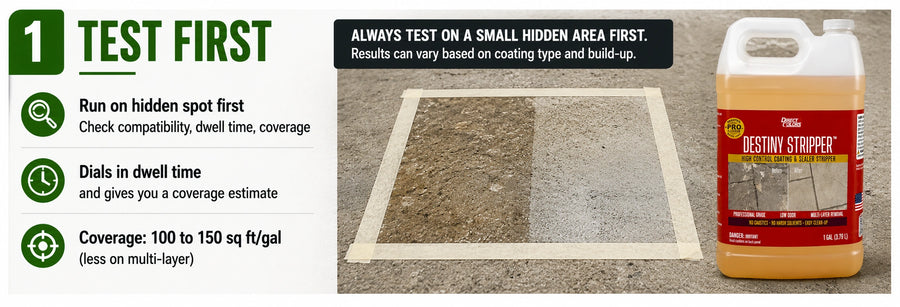
Step 1: Test Destiny Stripper™ on a small hidden patch first. Confirms it works on your coating and dials in dwell time.
2. Conditions and prep.
- Surface and air temperature must be above 45°F.
- Mask adjacent surfaces, baseboards, and drains with polyethylene sheeting and tape.
- On pool decks, shut off the pool pump and keep all product and slurry out of the water.
- Don't use on vinyl, VCT, or rubber substrates.
- Not designed for vertical surfaces.
- When working outdoors, covering the product with a plastic blanket helps prevent evaporation. If the product evaporates, it stops working.
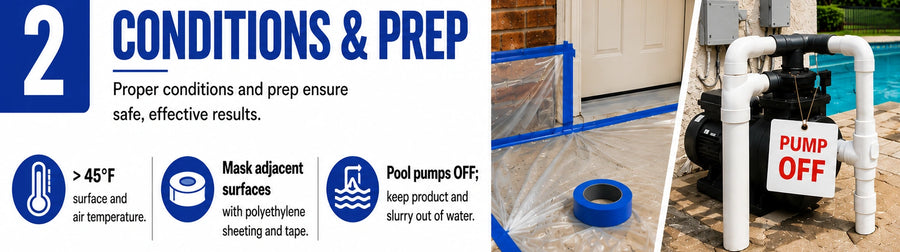
Step 2: Mask adjacent surfaces, baseboards, and drains. Confirm surface and air temperature above 45°F. Protect any water features.
3. Apply (rolling or mopping is recommended).
- 1. Plan your work in sections, breaking at walls, expansion joints, or control lines so the product doesn't dry before you can remove the coating.
- 2. Wet the surface completely with Destiny Stripper™. Apply a thick, even coat. Do not spread thin.
- 3. Agitate with a coarse nylon brush after application to push the product into the coating.
- 4. While the surface is shiny and wet, the stripper is actively working. A dull surface means it needs to be reapplied.
- 5. Mix the product every time before you apply or dip your application tool. The active ingredients settle.
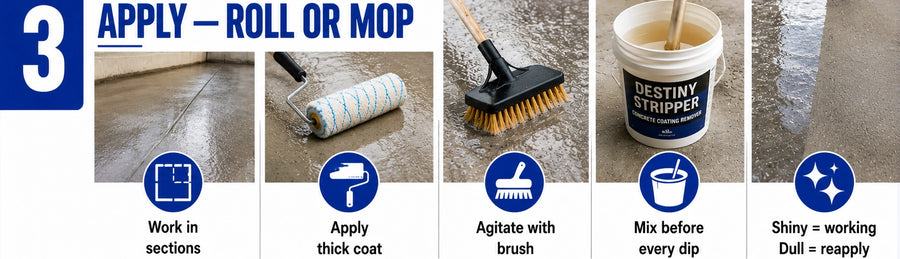
Step 3: Apply a thick, even coat with a roller or mop, then agitate with a coarse nylon brush to push the product into the coating.
4. Do not let it dry.
- If Destiny Stripper™ dries before the coating releases, the coating can reconstitute and bond back to the slab.
- In hot or dry conditions, cover the treated area with polyethylene sheeting to extend working time.
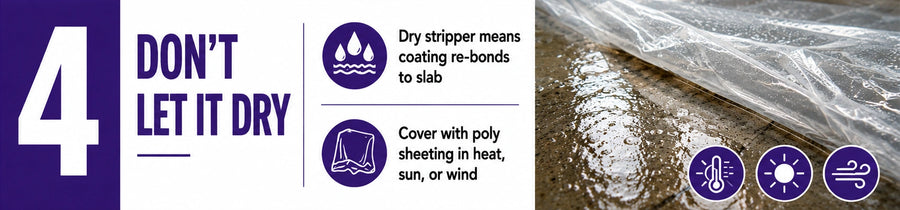
Step 4: Don't let the stripper dry. Cover with polyethylene sheeting in hot or dry conditions to extend working time.
5. Readiness test.
- Dwell time: a few minutes to several hours, depending on coating thickness.
- Scratch a small spot with a putty knife or scraper.
- If the coating releases easily, it's ready to remove.
- If not, give it more time and reapply if the stripper has gone dull.
- Some coatings turn gooey rather than fully liquid. Keep agitating and applying until the film fully lifts.
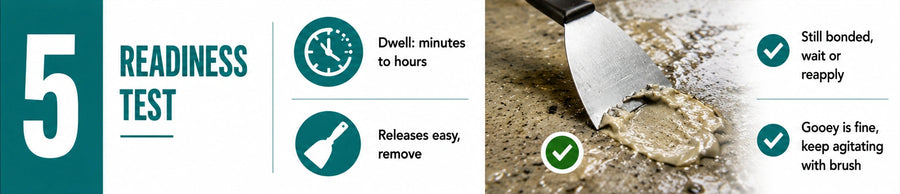
Step 5: Readiness test. Scratch a small spot with a putty knife. If the coating releases easily, it's ready to remove.
6. Remove.
- Manual: scrapers, floor squeegees, or a low-speed buffer with strip pads or brushes.
- Pressure washing: high-pressure hot water; a rotary turbo nozzle increases speed.
- For easier cleanup, spray a 1:1 mix of water and Destiny Stripper™ over the softened coating before scraping.
- Pull slurry and coating residue with a wet/dry vac BEFORE rinsing. Never flush slurry into drains, pools, or public waterways.
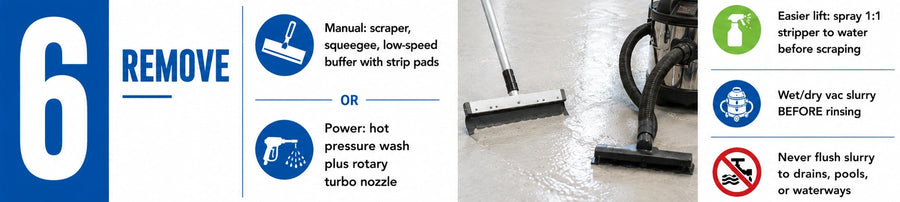
Step 6: Remove the softened coating. Pull slurry with a wet/dry vac before rinsing. Never flush into drains, pools, or public waterways.
Safety.
- Wear chemical-resistant gloves, eye protection, and protective clothing.
- Softened coating is extremely slippery. Watch your footing.
Mechanical removal
For very thick sealer build-up or chemically resistant films, sometimes the only option is mechanical grinding: a low-speed floor buffer with a black or brown stripping pad, or in severe cases a diamond grinder.
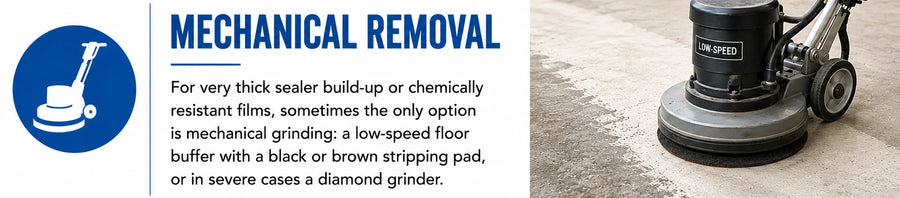
Mechanical grinding with a low-speed buffer or diamond grinder is the last resort for thick or chemically resistant films.
After stripping or grinding
- 1. Clean the slab thoroughly with ProClean Degreaser™ diluted per the spec sheet.
- 2. If you need to re-etch before resealing, use CitrusEtch™ followed by ProClean Neutralizer™.
- 3. Rinse thoroughly with water and extract with a wet/dry vac until the rinse water runs clear.
- 4. White rag test to confirm the slab is clean. If the rag comes off gray or with sealer residue, rinse again.
- 5. Allow 24 to 48 hours for the slab to fully dry.
- 6. Water absorption test before resealing. Drop a small puddle of water on the slab. If it beads up or sits, the pores are still closed. Re-etch and re-test. If it absorbs within a minute or two, the surface is open and ready for sealer.
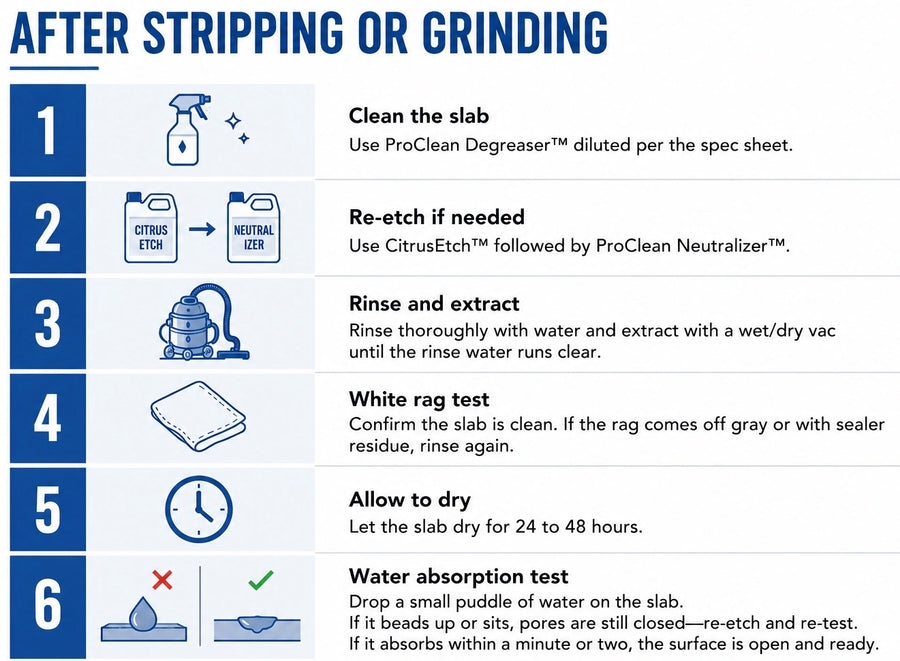
Water absorption test: beading means re-etch. Absorption within a minute or two means the slab is open and ready for the new sealer.
When to call Direct Colors
Some failures aren't DIY-recoverable. Call us if any of these apply:
- The peel covers more than 30% of the slab
- You've stripped and re-sealed twice and the problem keeps coming back
- The sealer turned milky white WITH visible water stains, efflorescence, or rising moisture (the issue is the slab itself, not the application)
- The substrate is damaged: delamination, scaling, soft spots, or alkali-silica reaction
- You're not sure what chemistry the previous sealer was, and your strip attempts aren't fully removing it
We can help diagnose, recommend the right system, and connect you with a local applicator if mechanical removal or substrate repair is needed. Contact Direct Colors with photos of the failure and a brief history (product used, application date, weather conditions, and slab age) and we'll route it to the right specialist.
Frequently asked questions
How long should I wait before deciding the sealer failed?
Wait 7 to 10 days at room temperature before declaring failure. Solvent sealers in particular can stay slightly tacky for a full week in cool or humid weather. If the slab is still uneven, milky, sticky, or peeling after 10 days, it's a real failure and needs intervention.
Can I use EasyRepair™ on AcquaTint™ or EasyTint™?
EasyRepair™ works on solvent-based sealers only, so it can re-flash EasyTint™ but not AcquaTint™ (water-based). Test on an inconspicuous spot first to confirm color stability before treating the whole slab.
Can I just put a fresh top coat over a failed sealer?
No. Layering a new sealer over a milky, peeling, or tacky sealer traps the failure under both films. The milkiness will continue to show through. Peeling propagates upward into the new coat. Strip the failed sealer first, then start fresh.
How do I tell if it's moisture or something else?
If the milky or hazy appearance changes with the weather (worse on humid days, better on dry days), it's moisture. If it stays the same regardless of weather, it's chemistry: under-cured, residual acid from a skipped neutralizer, or two incompatible sealer chemistries layered together.
What's next
- 1. Picking the right sealer for the recovery → The Best Concrete Sealer for Your Slab: How to Choose
- 2. The full application guide → How to Apply Concrete Sealer the Right Way
- 3. Re-flash a solvent-based failure → EasyRepair™
- 4. Strip a water-based failure → Destiny Stripper™
- 5. Talk to us → Contact Direct Colors
Direct Colors has manufactured decorative concrete products in Shawnee, Oklahoma since 1997. We make every product in the system that touches your slab (Prep, Stain, Seal, and Maintain) under one roof. That's why our sealer failures usually have a clean recovery path.
Direct Colors. Shawnee, OK. Manufacturing the full decorative concrete system since 1997.


