
A sealer job lasts five years or fails in five months based on three things: how clean the slab was, the temperature and dew point during cure, and the technique with the applicator. Get those three right and almost any quality sealer will perform. Get any one of them wrong and even the best product peels.
This guide walks through the application of the Direct Colors sealer system. Same framework whether you're sealing a stained patio, a polished basement floor, a garage, or a poured driveway.
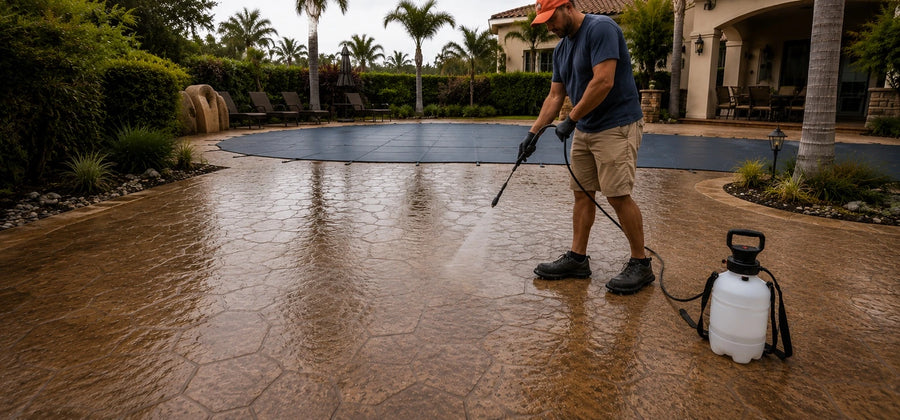
HydroCryl™ applied to a stamped concrete pool deck with a pump sprayer.
If you are a professional contractor go to the Pro's Sealer Playbook →
What you need before you start
Pull these together before opening any product. Stopping mid-application to find a missing tool means an uneven coat.
Tools and materials:
- The right sealer for your slab (see how to choose)
- Applicator: 3/8" nap roller (solvent-resistant for EasySeal™) or pump sprayer (chemistry-dependent, see Step 3)
- Roller frame and extension pole for floor work
- Painter's tape and plastic sheeting for masking
- Cardboard or scrap surface for priming the sprayer before each session
- ProClean Degreaser™, CitrusEtch™, and ProClean Neutralizer™ for prep
- HEPA-rated vacuum or shop vac
- Garden hose with adjustable nozzle
- Stiff-bristle nylon scrub brush
- Wet/dry shop vac for rinse water extraction
- Cotton wiping rags
- Gloves, safety glasses, NIOSH-rated respirator
Time budget:
- Prep: 4 to 8 hours depending on slab condition
- Slab dry time after final rinse: 24 to 48 hours
- Sealer application: 1 to 2 hours per coat
- Cure between coats: 30 minutes to 8 hours depending on chemistry
- Full cure before traffic: 24 to 72 hours
Have you already prepped and stained the slab?
If you've already cleaned, etched, neutralized, and stained with Direct Colors products, you're sealing as Step 3 of the system.
YESNOStep 1: Prep the slab
The bulletproof prep sequence is CLEAN → ETCH → NEUTRALIZE → RINSE. Skip a step and the sealer comes off in sheets within a year.
Pool decks and water features: protect the water first. If you're sealing concrete around a pool, hot tub, fountain, or any water feature, protect the water before any prep starts. Two options:
- Cover the entire pool or feature with a fitted pool cover or heavy plastic sheeting
- Mask the perimeter where the deck meets the water with painter's tape and 2-3 mil plastic sheeting, and keep all CitrusEtch™, rinse water, and sealer at least 2-3 inches back from the edge
Acid etch runoff, degreaser, and sealer chemistry will throw off pool water balance and can stain coping or tile. Don't skip this step on water-adjacent work.
CLEAN. Vacuum loose debris with a HEPA-rated vacuum. Apply ProClean Degreaser™ to concrete to remove oil spots, automotive stains, and grease zones. Scrub with a stiff nylon brush in the direction of the slab. Rinse thoroughly.
ETCH. Pour CitrusEtch™ evenly across the slab. Work it into the surface with a stiff brush for 10 to 15 minutes. The slab will fizz mildly as the acid opens the pores. Etching is what gives the sealer something to grip.
NEUTRALIZE. Apply ProClean Neutralizer™ immediately after etching. This shuts down the acid reaction and prepares the surface to receive the sealer. Skip this step and the sealer will react with residual acid and turn cloudy as it cures.
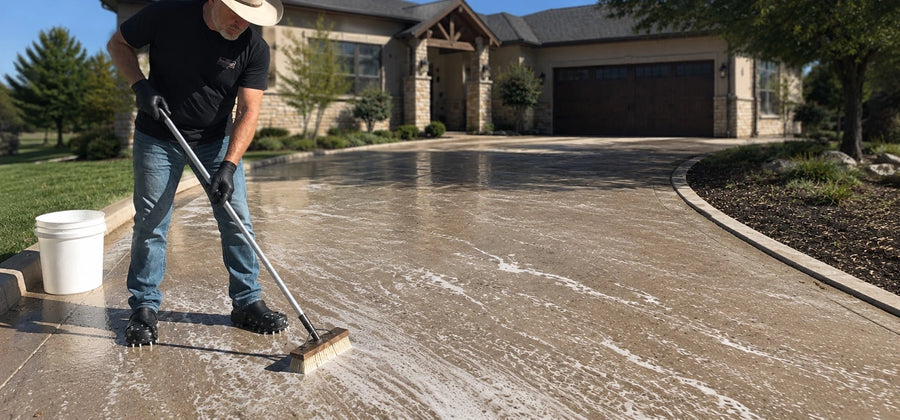
Etching the driveway with CitrusEtch™ opens the concrete pores so the sealer has something to grip.
RINSE. Pressure-wash or hose-flood the slab. Vacuum standing water with a wet/dry shop vac. Repeat until the rinse water comes off clear.
The white rag test. Wipe a clean white rag across the dry slab after the final rinse. If the rag comes off gray, the slab is not clean enough. Rinse again.
Already prepped and stained?
Read this before Step 2
If you're sealing as Step 3 of the Direct Colors system — you've already cleaned, etched, neutralized, and stained the slab — skip the prep sequence above. Do not re-etch a stained slab. Etching strips color and erases your stain work.
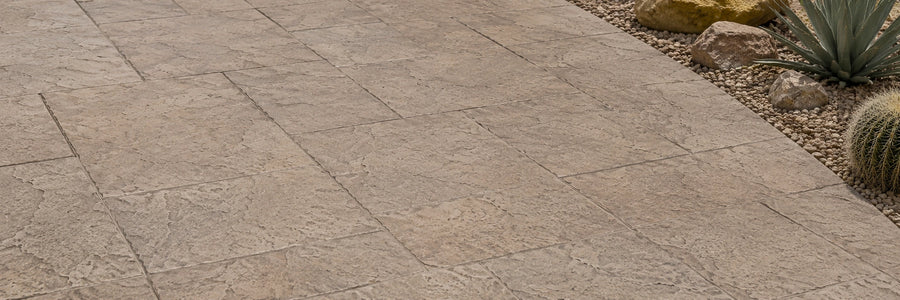
Stained stamped concrete with no sealer yet. Once the five checks below pass, this slab is ready for Step 2.
Before moving to Step 2, confirm these five things:
1. The stain is fully cured and dry
- Water-based stains (ColorWave®): at least 2 hours after the final stain coat, and the slab must be completely dry to touch.
- Acid stains (EverStain™): the slab must be neutralized, rinsed clean, and dried for at least 24 hours after the final rinse before sealing.
2. No stain residue is left on the surface
EverStain™ leaves a chalky or colored residue from the acid-and-metal reaction. This must be cleaned off before sealing, or the residue gets trapped under the sealer and the finish looks dusty or uneven. Neutralize with ProClean Neutralizer™, rinse with water, extract with a wet/dry vac, and repeat until the rinse water runs clear. Confirm with the white rag test.
Water-based stains generally leave less residue, but wipe the slab with a damp microfiber cloth before sealing to catch any dust or overspray.
3. The stain wasn't applied too thick
A thick stain coat is not a darker stain coat. When stain is applied too heavy, the pigment piles up on the surface instead of penetrating the concrete pores. The sealer then bonds to that loose pigment layer instead of the concrete itself and peels off in sheets within months because the pigment underneath has no real bond to the slab.
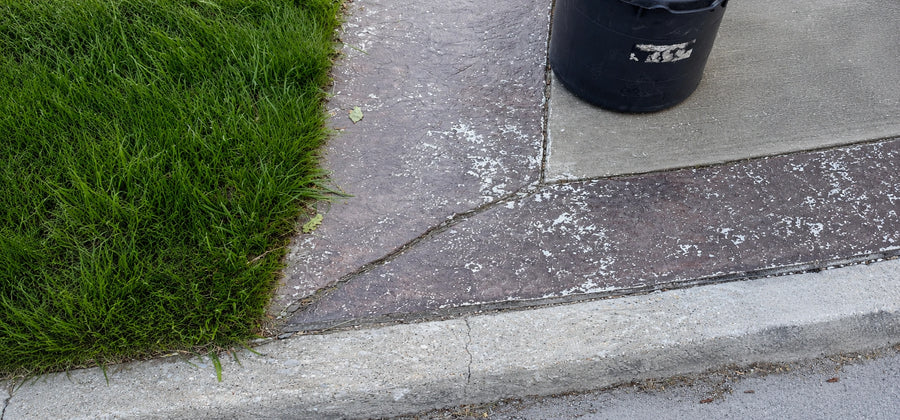
How to spot over-application:
- The cured slab feels chalky or powdery when you rub it with a clean hand
- Color rubs off on a damp white rag
- Visible pooling, dried ridges, or shiny patches of stain at low spots
If you see any of these, remove the loose pigment layer before sealing:
- Scrub the slab with ProClean Neutralizer™ and a stiff nylon brush.
- Rinse and extract with a wet/dry vac until the rinse water runs clear.
- Repeat the white-rag test until the rag comes off clean.
- Let the slab dry 24 hours before sealing.
Better: stain in thin, layered coats. Two thin coats give deeper, truer color than one heavy coat — and the bond between stain, concrete, and sealer stays intact.
4. The slab is dust-free
If the stained slab has been exposed to dust, construction debris, weather, or has sat unsealed for more than a few days, a quick vacuum pass is not enough. Deep broom the slab first to dislodge embedded dust from the open pores, then vacuum thoroughly. Repeat the broom and vacuum cycle until no dust comes up.
For freshly stained slabs being sealed the same day, a single HEPA vacuum pass is usually enough.
Any dust left on the slab gets locked in under the sealer and shows in the cured finish as a hazy or speckled appearance.
5. Sealer compatibility
Any Direct Colors sealer works over any Direct Colors stain. Pick your sealer based on the slab location and finish (see how to choose), not the stain chemistry.
Once these five checks pass, move to Step 2 and proceed normally.
Step 2: Check temperature and dew point
This is the rule nobody talks about and the rule that ruins more sealer jobs than any other.
The 5°F dew point rule. Slab temperature must stay at least 5°F above the dew point during the entire application and cure window. If the slab sits at 65°F and the dew point is 62°F, condensation will form under the sealer as it dries. The sealer turns milky and never recovers.
How to check:
- Get slab surface temperature with an infrared thermometer
- Get the current dew point from a weather app
- Subtract: slab temp − dew point ≥ 5°F → green light
- Check the forecast for the next 24 hours, not just the current reading
Other weather rules:
- Application temperature: 60°F to 90°F
- No application in direct sun on a 90°F+ day. The sealer flashes off before it can level.
- No application within 24 hours of rain. The slab needs to be bone dry.
- No application during humidity above 85%
If you can't hit the dew point margin outdoors, wait for a better day. Indoors, run dehumidifiers for 24 hours before applying.
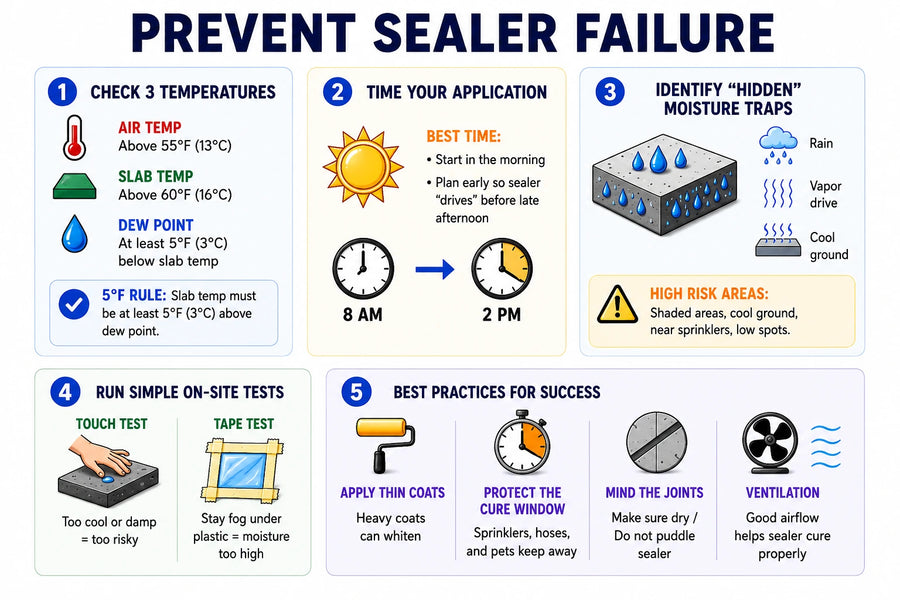
The dew point checklist: slab temp must stay at least 5°F above the dew point through the entire application and cure.
Step 3: Choose your applicator
The right applicator depends on the chemistry of the sealer, not personal preference.

The three tools that do the work: high-solids sprayer with fan-tip nozzle, 3/8" nap roller, and spiked shoes to cross wet sealer without leaving prints.
| Sealer | Best applicator | Coverage | Coats | Walk-on time |
|---|---|---|---|---|
| HydroCryl™ | Pump sprayer and/or 3/8" nap roller | 200 sq ft/gal | 2 | 24 hours |
| EasySeal™ | High-solids sprayer with fan-tip nozzle and/or solvent-resistant 3/8" nap roller | 200 sq ft/gal | 2 | 48 hours |
| AcquaSeal™ | Pump sprayer and/or 3/8" nap roller | 200 sq ft/gal | 2 | 24 hours |
| EasyCureSeal™ | Pump sprayer only | 200 sq ft/gal | 1 | 48 hours |
| ProSeal Li™ | Pump sprayer | 200 sq ft/gal | 2 | 2 hours |
- HydroCryl™. Pump sprayer and/or 3/8" nap roller. 200 sq ft/gal. 2 coats. Walk-on in 24 hours.
- EasySeal™. High-solids sprayer with fan-tip nozzle, or solvent-resistant 3/8" nap roller. 200 sq ft/gal. 2 coats. Walk-on in 48 hours.
- AcquaSeal™. Pump sprayer and/or 3/8" nap roller. 200 sq ft/gal. 2 coats. Walk-on in 24 hours.
- EasyCureSeal™. Pump sprayer only. 200 sq ft/gal. 1 coat. Walk-on in 48 hours.
- ProSeal Li™. Pump sprayer. 200 sq ft/gal. 2 coats. Walk-on in 2 hours.
Why chemistry decides the tool. The acrylic sealers (HydroCryl™, EasySeal™, AcquaSeal™) all work with either a pump sprayer or a 3/8" nap roller. EasySeal™ specifically requires a high-solids sprayer with a fan-tip nozzle. A standard yard or garden sprayer can't handle the solvent-based formula and will clog or spray unevenly. If rolling EasySeal™, the nap must be solvent-resistant or the solvent will dissolve the roller. Penetrating sealers (ProSeal Li™) and cure-and-seal products (EasyCureSeal™) require a pump sprayer because there is no film to spread with a roller.
Rough or porous surfaces drink more sealer. Stamped concrete, broomed driveways, pavers, exposed aggregate, and other high-texture slabs can absorb 25 to 40 percent more sealer than a smooth interior floor. Plan for additional coats or expect coverage closer to 130 to 150 sq ft per gallon on the most porous substrates. Test a small area first to gauge absorption before buying your final quantity.
Step 4: Apply the sealer
Boxing rule. If you're using more than one container of the same product, pour all gallons into a single 5-gallon bucket and mix them together before starting. Concrete sealers can have minor color or sheen variation from batch to batch.
Pour and spread method (nap roller). Pour an 8-inch stripe of sealer onto the slab. Roll it out evenly in W-shapes, working from one wall toward the door so you don't paint yourself in. Each pass should overlap the previous one by a third. Don't go back over a section that has started to skin over. You'll leave roller marks.
Pump sprayer method. Always prime the sprayer on cardboard or a scrap surface before touching the slab. The first 2 to 3 seconds of spray often drip, sputter, or run uneven while pressure builds. That first burst sprayed directly onto your slab creates an over-saturated spot that dries differently than the rest of the floor. Once the spray pattern is steady and consistent, move to the slab: adjust to a fine fan pattern, hold the wand 12 to 18 inches above the slab, walk at a steady pace overlapping each pass by 50%, and back-roll lightly with a nap roller if the spray needs leveling. For EasySeal™, use a high-solids sprayer with a fan-tip nozzle. Standard pump sprayers can't handle the solvent-based viscosity and will clog or spray inconsistently.
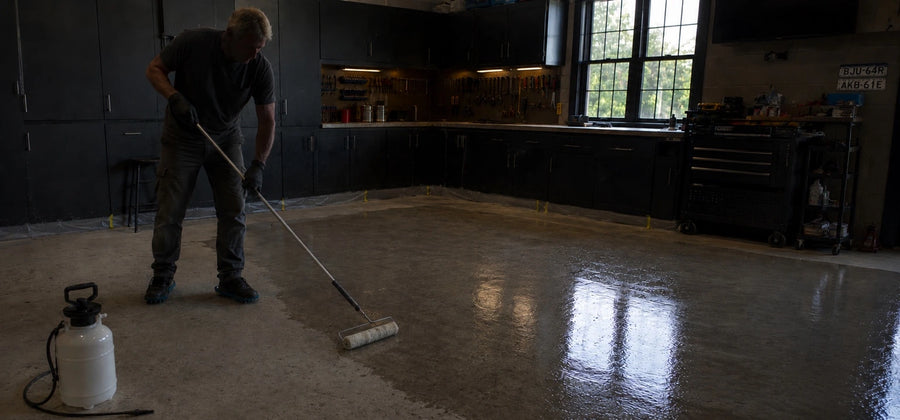
Rolling sealer with a 3/8" nap roller in W-shaped passes for even coverage.
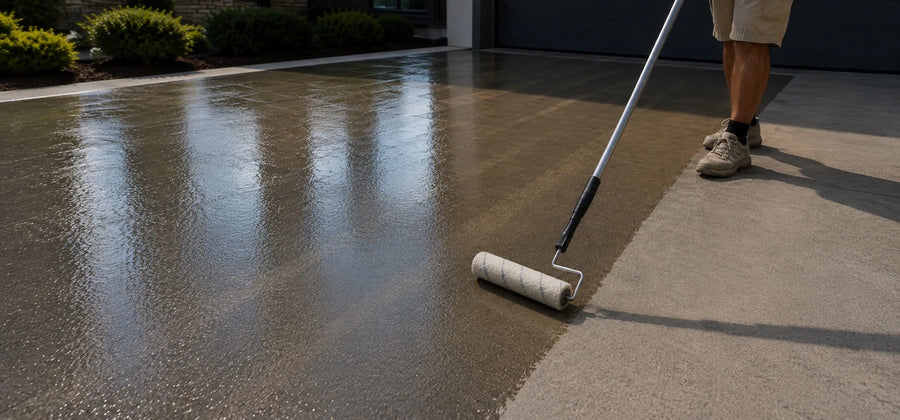
Close-up of nap roller technique: thin even coats, no return passes over skinned-over sections.
Don't over-apply. A thick coat does not last longer than a thin coat. It traps solvent or water as it dries and turns milky. Aim for the manufacturer's coverage rate of 200 sq ft per gallon.
Step 5: Cure and recoat
Wait for the first coat to cure before applying the second. Check the spec sheet for your specific product, but typically:
- Water-based sealers (HydroCryl™, AcquaSeal™): 30 to 45 minutes between coats
- Solvent-based sealers (EasySeal™): 4 to 8 hours between coats
- Penetrating sealers (ProSeal Li™): wait for full cure per spec sheet before second coat
Test for cure. Press a finger firmly into a corner of the dried sealer. If it feels tacky or leaves a mark, wait longer. If it's firm and slick, apply coat two.
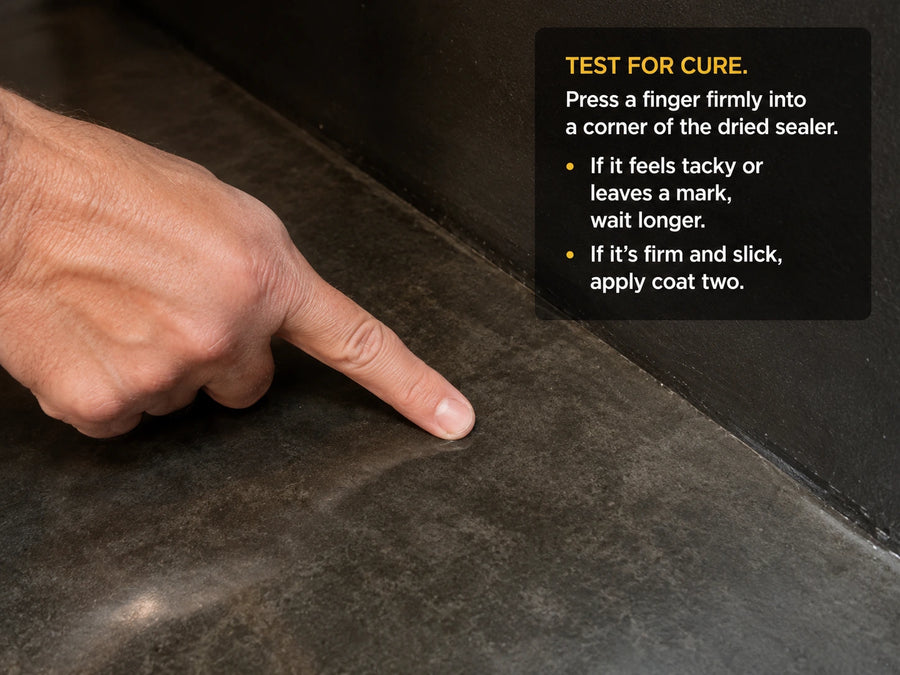
The finger-press test: firm and slick means ready for the next coat.
Don't walk on it early. Foot traffic too soon leaves prints that never fade. Vehicle traffic too soon embeds tire ghosts. Follow the walk-on time in the Step 3 table, then add 24 hours for safety before heavy use.
How to seal concrete countertops
For concrete countertops, use HydroCryl™. It's water-based, ultra-low VOC, safe in occupied homes, and scored 88 out of 90 against common household chemicals in lab testing, including the things countertops actually meet: cooking oils, citrus, wine, and cleaning products.
Countertops change the application playbook in three ways: smaller surface, finer applicator, and a longer wait before the surface goes back into service.
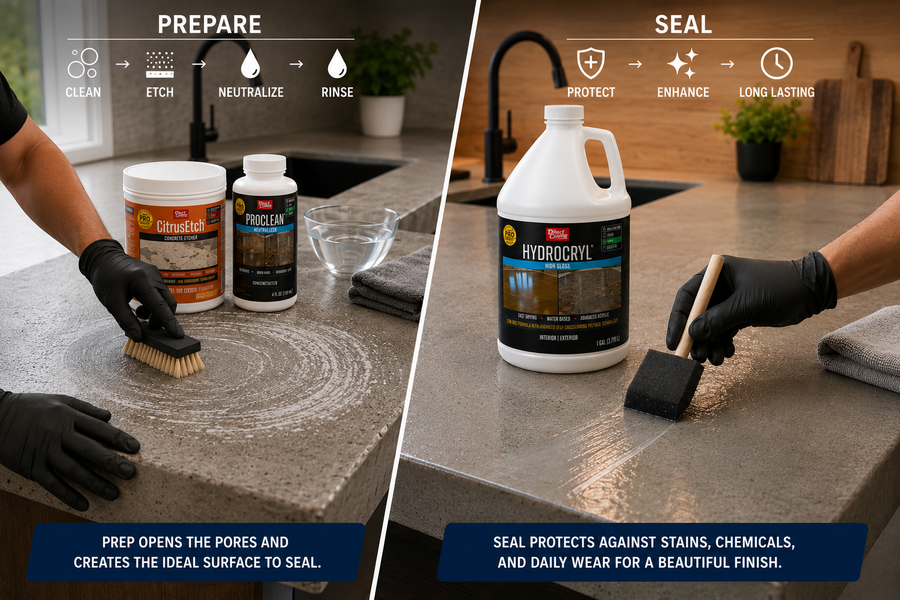
Countertop two-step: PREP opens the pores with CitrusEtch™ and ProClean Neutralizer™. SEAL with HydroCryl™ for stain, chemical, and daily-wear protection.
Prep is the same
CLEAN → ETCH → NEUTRALIZE → RINSE applies to countertops just like floors (see Step 1). Etching is critical. A polished concrete countertop without proper etching gives HydroCryl™ nothing to grip.
Apply with a foam brush or fine nap pad
Skip the roller and sprayer for countertops. Use a 4" foam brush, a microfiber applicator pad, or a fine-nap mini roller (6" or smaller). These leave a smoother finish on a small, visible surface.
- Apply thin even coats. Three to four thin coats give better protection than two thick coats on a countertop.
- Lightly sand with 400-grit sandpaper between coats once each coat fully cures. This removes dust nibs and improves adhesion of the next coat.
- Don't forget the edges and the underside of the slab if it's a free-standing piece. Water and grease will find any unsealed surface.
Cure before food contact
HydroCryl™ is dry to touch in about 30 minutes and walkable in 24 hours, but countertops need a longer full cure before food contact. Wait at least 7 days at room temperature before putting prepared food directly on the surface. Use cutting boards. Don't cut directly on the sealer because a knife will scratch any acrylic.
Optional: ProWax Polish™ topcoat
For high-traffic counters like bar tops and kitchen islands, ProWax Polish™ on top of cured HydroCryl™ adds a sacrificial polish layer that absorbs daily scratches. Refresh with a microfiber pad every 6 to 12 months. Strip and reapply if it dulls.
Maintenance
Clean with pH-neutral cleaners. Avoid bleach, ammonia, and abrasive pads. They dull the sealer over time. Wipe spills promptly. If a stain sets in, a fresh coat of HydroCryl™ on top usually restores the finish.
Need extra grip? Add OxiGrip™ to the last coat
For pool decks, outdoor stairs, ramps, garage entries, shaded patios, and commercial entryways, mix OxiGrip™ Anti-Slip Additive into the last coat of sealer only. Earlier coats do not need the additive. The slip resistance comes from the surface layer.
Compatibility: Works with HydroCryl™, AcquaSeal™, and EasySeal™. Not compatible with AcquaTint™ or EasyTint™.
Mix ratio
Pour the additive into the sealer, let it settle for a moment, then shake or stir to suspend it evenly.
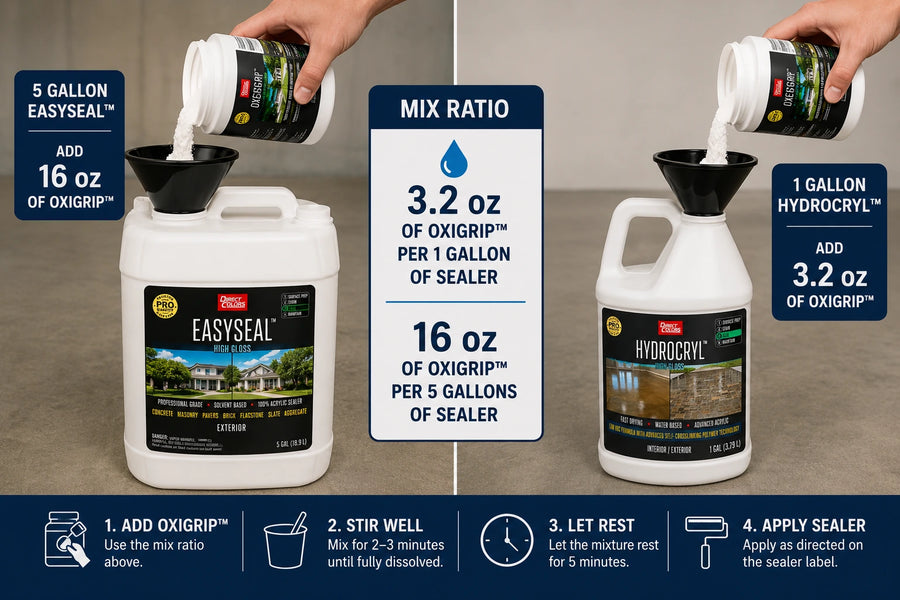
OxiGrip™ mix ratios for HydroCryl™ and EasySeal™: 3.2 oz per gallon, or 16 oz per 5-gallon container.
Application
Apply with the same applicator you used for the earlier coats (pump sprayer or 3/8" nap roller). The critical rule is to keep the additive suspended in the sealer throughout the entire application. The additive settles fast.
- Roller: Agitate the additive into the sealer with each dip. Wring out excess to keep coats thin.
- Sprayer: Shake the sprayer tank side to side regularly to keep additive suspended.
Tool cleanup (sprayers, rollers, pads):
- EasySeal™: Clean tools and applicators with xylene while the sealer is still wet. Xylene will dissolve cured EasySeal™, so never use it on the slab surface or to clean spills after the sealer has set.
- AcquaSeal™: Clean tools with ProClean Degreaser™ and warm water.
- HydroCryl™: Clean tools with warm water before the sealer dries.
Important. OxiGrip™ adds slip resistance but is not considered a "slip-proof" product.
Interior floors: finish with ProWax Polish™
For any interior floor, top your cured sealer with ProWax Polish™. ProWax is a sacrificial polymer wax that absorbs daily scratches and scuffs, protecting the sealer underneath. It adds ultra-high-gloss "wet look" shine that makes stain colors pop. Refreshes with a mop, no stripping required.
Apply ProWax Polish™ with a microfiber mop in thin even coats. Two coats is standard for most interior floors. Wait 30 minutes between coats. Let cure 24 hours before walking on it in shoes.
Do not use ProWax on exterior surfaces. It is not designed for UV exposure or freeze-thaw cycles.
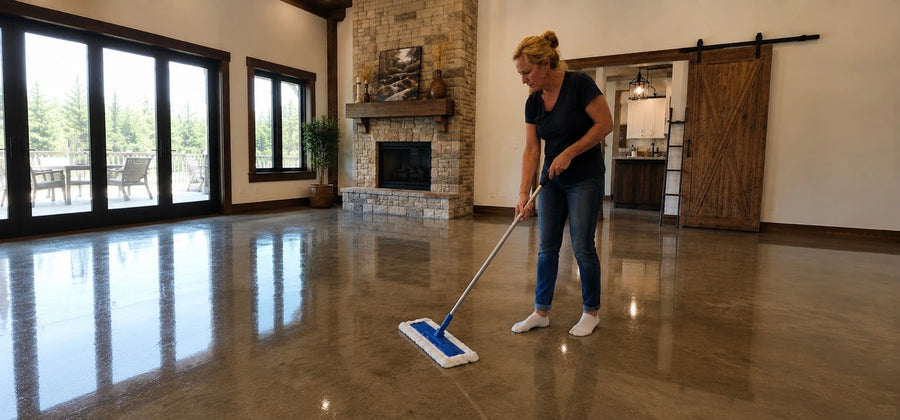
ProWax Polish™ applied to a finished interior concrete floor with a microfiber mop.
ProWax Polish™ is the only burnishable concrete wax on the market
Burnishing with a low-speed floor buffer (175 to 300 RPM) and a white or red polishing pad works the wax deeper into the surface and creates a harder, glossier, more durable finish than mop application alone. Burnish 24 hours after the final mop coat once the wax has fully cured. Re-burnish every 6 to 12 months to refresh the gloss and extend the life of the wax layer without stripping or reapplying.
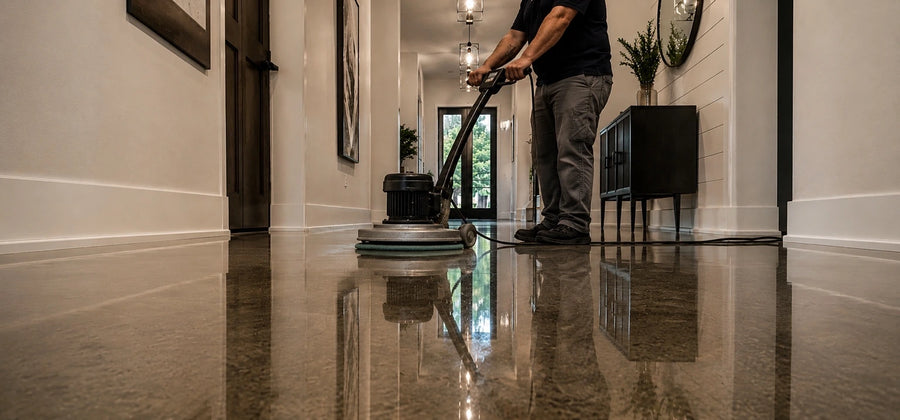
Burnishing ProWax Polish™ with a low-speed floor buffer for a harder, glossier, longer-lasting finish.
No other concrete floor wax can be burnished this way. The combination of mop-on application and burnishable durability is unique to ProWax Polish™.
Common mistakes that ruin sealer jobs
- Skipping the etch step on raw concrete (no bite, sealer peels)
- Skipping the neutralizer (sealer goes cloudy as residual acid reacts)
- Re-etching a stained slab (etching strips color and erases the stain work)
- Sealing over EverStain™ residue (chalky residue gets trapped under the sealer and the finish looks dusty)
- Sealing over stain that was applied too thick (the pigment piles up on the surface instead of penetrating; the sealer bonds to the loose pigment layer and peels off in sheets within months — stain in thin, layered coats and check with the white-rag test before sealing)
- Skipping the deep broom and vacuum on a stained slab that's sat unsealed or been exposed to dust (embedded dust locks in under the sealer as haze or specks — deep broom first, then HEPA vacuum until no more dust comes up)
- Sealing a pool deck without protecting the water (etch runoff, degreaser, and sealer overspray will throw off pool chemistry and can stain coping; cover the pool or mask the perimeter)
- Sealing over a damp slab (sealer turns milky white and stays that way)
- Applying in direct sun (sealer flashes before it can level)
- Applying below the 5°F dew point margin (condensation under the sealer)
- Too-thick coats (traps solvent or water, clouds as it dries)
- Walking on it too early (footprints lock in permanently)
- Spraying directly onto the slab without priming the sprayer first (the initial spray burst drips or sputters and leaves an over-saturated spot; always prime on cardboard or scrap until the spray pattern is steady)
- Using a non-solvent-resistant roller with EasySeal™ (solvent dissolves the nap, fibers stick to the slab)
- Using a standard pump sprayer or yard sprayer for EasySeal™ (the solvent clogs the seals and the spray pattern goes uneven — EasySeal™ needs a high-solids sprayer with a fan-tip nozzle)
- Using EasyRepair™ on a water-based sealer (chemistry destroys the finish; EasyRepair™ is for solvent-based sealers only)
- Using xylene to clean spills or surfaces after EasySeal™ has cured (xylene dissolves the finish; it's a tool-cleanup solvent for wet sealer, not a surface cleaner)
Frequently asked questions
How long before I can park a car on a newly sealed driveway?
Wait at least 72 hours after the final coat before driving on it, longer in cool or humid weather. Heavy vehicle traffic should wait 7 days. The sealer needs full cure time to harden enough to resist tire ghosting.
Can I apply sealer over a sealer that's already on the slab?
Only if both are the same chemistry. Water-based over water-based, solvent over solvent. Mixing chemistries causes peeling. If you don't know what the existing sealer is, the safe move is to strip the old sealer first with a citrus stripper, then start fresh.
Do I need to seal new concrete right away?
For freshly poured concrete, use EasyCureSeal™ within the first day of placement. It's specifically designed for fresh wet concrete. For older slabs, you can seal anytime once the concrete is fully cured (28 days minimum) and dry.
What if my sealer turned milky white?
That's almost always trapped moisture. Either the slab was damp when you sealed, or condensation formed under the film during cure (the dew point rule). For solvent-based sealers, EasyRepair™ can sometimes re-flash the finish. Water-based sealers usually have to be stripped with Destiny Stripper™ and reapplied. Full recovery guide: How to Fix a Failed Concrete Sealer.
What's next
- Still picking your sealer? → The Best Concrete Sealer for Your Slab: How to Choose
- Sealer already failed? → How to Fix a Failed Concrete Sealer
- Browse the full sealer lineup → Acrylic Concrete Sealers
- Add the finishing layer → ProWax Polish™
- Talk to us → Contact Direct Colors
Direct Colors has manufactured decorative concrete products in Shawnee, Oklahoma since 1997. We make every product in the system that touches your slab — Prep, Stain, Seal, and Maintain — under one roof.
Direct Colors. Shawnee, OK. Manufacturing the full decorative concrete system since 1997.


