
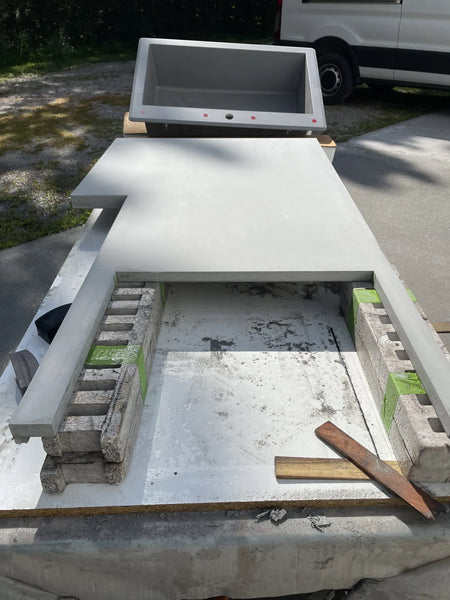
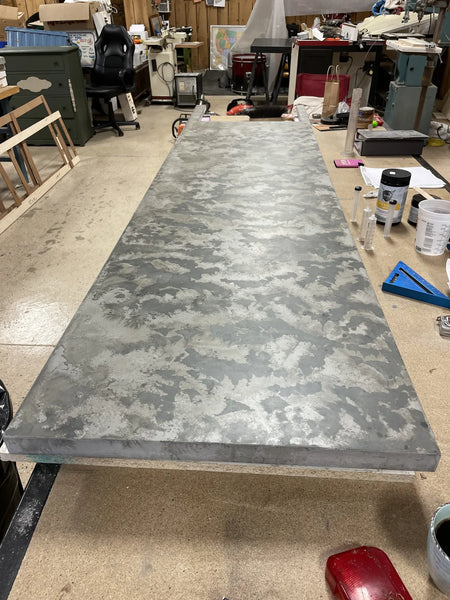
Pouring a countertop in place means casting it on the cabinets rather than casting it elsewhere and lifting it on. For a heavy top it is often the only sensible option — the average concrete countertop weighs up to 900 lb — but it brings the mess into your kitchen for the duration. Here is the method, and an honest account of the trade-offs.
Shop Countertop Stains & Trial Kits →
The method
- Calculate your mix quantity and add 10% for waste and for slurry to fill pinholes
- Reinforce the cabinetry to carry the weight — up to 900 lb
- Build the forms. Plexiglas or melamine gives an extra-smooth face that needs less polishing
- If coloring integrally, calculate the pigment for your batch size and blend it thoroughly into the dry mix until the color is uniform — this is what prevents streaking
- Mix in a 5-gallon pail with a hand mixer and birdcage paddle: one gallon of water per 50 lb box, adding the mix a quarter at a time
- Coat the forms thoroughly with a form release agent
- Pour 3/8 inch of mix, press the first layer of fiberglass net into place and vibrate
- Keep the net at least ¼ inch below the finished surface or it will shadow through
- Pour the remaining mix and float the surface
- Lay a second cut-to-fit sheet of net on the surface, vibrate, and press it in until fully covered — this face becomes the bottom of the countertop
- Cure a minimum of 15 days
- Polishing to 3000 grit? Apply a penetrating sealer and keep polishing. Using polyurethane instead? Do not polish beyond 800 grit before you seal
Advantages
Disadvantages
If that disruption is unworkable, the alternative is to skim-coat the countertop you already have — see refinishing an existing countertop, which is a one- or two-day job instead.
Shop Countertop Stains & Trial Kits →
Poured-in-Place Tops: FAQs
Why pour a countertop in place rather than casting it?
Because it never has to be moved — that is the single biggest argument for the method. A top can weigh up to 900 lb, so it also suits large or awkward shapes and outdoor kitchens where lifting a slab is impractical.
How long does it take?
17 days, including a 15-day minimum cure — and realistically construction plus cure can run to 30 days with the kitchen out of action.
What are the real drawbacks?
Mess and disruption: mixing and pouring happen in the room, and equipment can damage flooring. A troweled poured-in-place top is also not as smooth as a pre-cast one without polishing.
Do the cabinets need work first?
Yes — reinforce the cabinetry to carry up to 900 lb before you pour anything.
What's Next
- Color it → Acid Stain Countertops
- A full build → Outdoor Kitchen Countertop, Start to Finish
- All countertop projects → DIY Concrete Countertop Ideas
- Applying stain outdoors → How to Apply Outdoor Concrete Stain
- Choosing a sealer → The Best Concrete Sealer
- Prefer a reactive, mottled look? → Acid Stain Colors Guide
- Shop → EverStain™ Kits · ColorWave® · Trial Kits
Direct Colors. Shawnee, OK. Manufacturing the full decorative concrete system since 1997.


