
Concrete used to be the thing you covered up. Decorative concrete changed that, and a colored, sealed slab is now a finished floor in its own right — which makes it a genuine alternative to the carpet that is probably already down. Eight comparisons below, and carpet does win two of them.
Prefer to listen? Shawna Turner on why concrete is the practical floor in a space that has flooded once. The player is at the end of this article.

A French bulldog choosing concrete.
1. Cost
Not a clean comparison, because concrete arrives at two very different price points.
If the slab is already there — a basement, a garage, a patio, or under carpet you are pulling up anyway — you are in the $1 to $3 range, which competes with the cheapest carpet available while lasting several times as long.
Verdict: carpet, by a small margin on most projects. Weigh it against longevity below.
2. Keeping the house clean
Concrete is easy to clean and to sanitize: it is solid, heat and moisture resistant, and effectively nonporous once properly sealed. A steam mop, a sanitizing wash, whatever the mess requires.
Carpet is one of the most difficult flooring materials to properly sanitize — followed by cork and natural wood. Even professional cleaning can leave bacteria behind, and it weakens the fibers while it works.
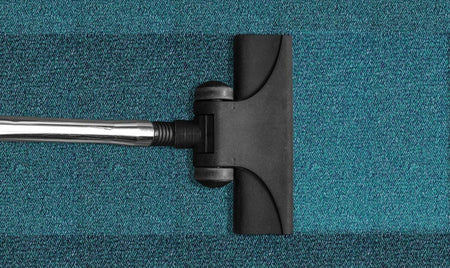
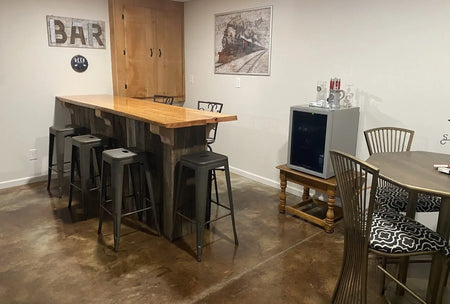
Verdict: concrete.
3. Versatility
Carpet comes in the colors and patterns designers chose based on recent trends. If it is not on the shelf, you cannot buy it. Concrete has no shelf: mix and match stains and dyes into any design you can picture, and combine them with stamping and engraving to imitate practically any material or era.
There are thousands of carpets. There is not a carpet for every idea.
Verdict: concrete.
4. Future renovations
Worth thinking about before you install anything. Carpet is awkward to stretch and staple in, and a real job to pull up and haul away once it is stained and worn.
People assume changing a concrete floor means grinding it back to bare gray. Often it does not — several of our colorants go over previously stained and sealed floors, so a change of color can be an application rather than a demolition. EasyTint™ and staining over stained concrete cover that route.
Verdict: concrete gets the edge, depending on how extreme the change is.
5. Sound control
This is carpet’s round and it deserves a straight answer. Noise is a real downside of concrete. In a large room with high ceilings and few soft furnishings, sound bounces off any hard floor, and carpet is genuinely the better choice for some open plans and hallways.
The counterargument is that rugs give you the same muffling without committing to permanent installation — including interlocking rug tiles that come up in minutes at the end of the day for cleaning. Consider the flexibility of rugs against the permanence of carpet before you decide concrete is too noisy.

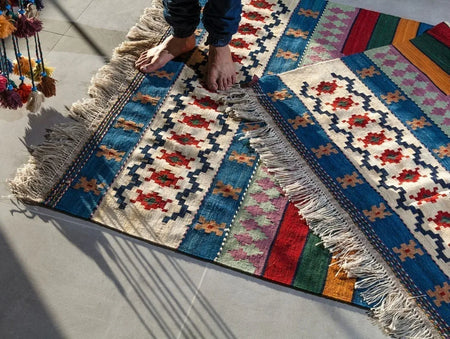
Verdict: carpet, with rugs closing most of the gap.
6. Longevity
Carpet always has a fixed lifespan. Even the toughest fibers and the most reinforced backing eventually give up under years of traffic. Concrete, maintained and resealed routinely, has a practically limitless one — it is the same slab the house is standing on.

A gray stained concrete basement floor.
Verdict: concrete.
7. Maintenance
Carpet needs vacuuming weekly and a deep clean at least annually — every six months with pets or children. Concrete needs a deep clean, a new coat of sealer every three to five years, and possibly a stain touch-up after a decade of heavy traffic. Between those, very little. A coat of ProWax Polish™ stretches the interval further by taking the wear instead of the sealer.
Verdict: concrete.
8. Kids and pets
Carpet has a reputation for being comfortable to roll around on, and that is fair. But concrete takes what pets and children dish out for years without scratching or chipping. A house full of new carpet can be stained and worn within months of a busy family tracking dirt across it — and consider a single drop of red wine or coffee.
Concrete is very hard to damage. When spills do happen there are several routes to cleaning or buffing them out depending on severity, and you can deliberately mix stain colors to disguise the marks a family will inevitably make — which is essentially impossible with carpet.
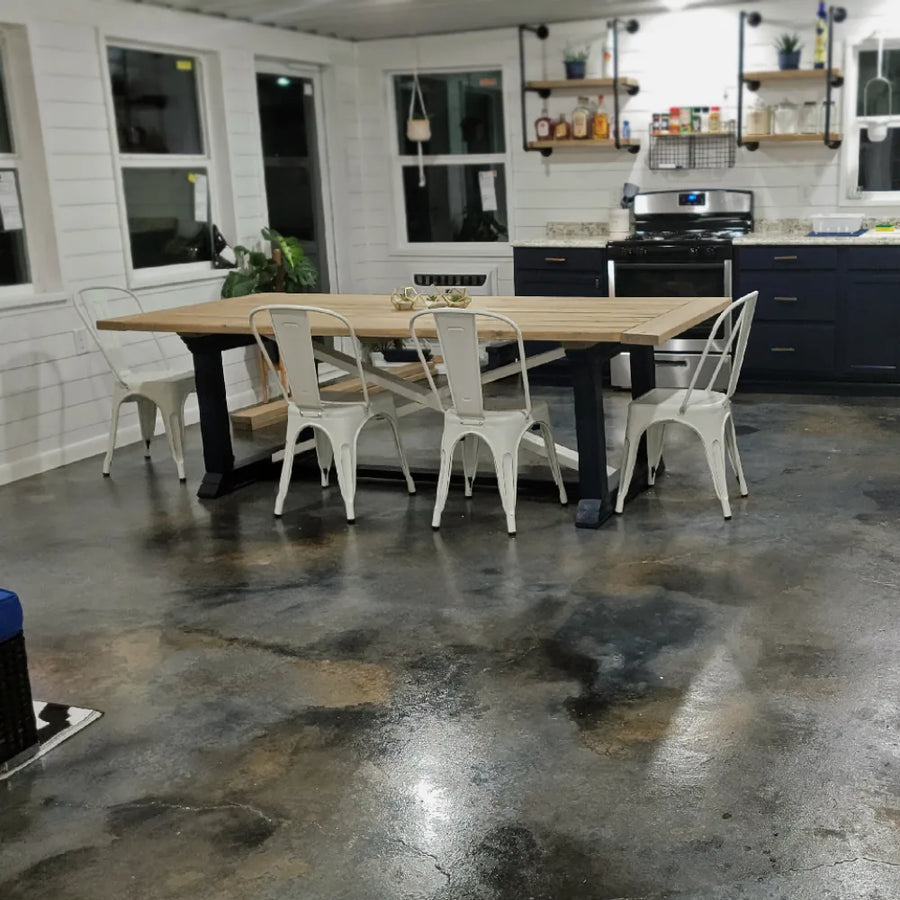
A ColorWave® floor in Black, Stone and Iron Gray.
Verdict: concrete.
The honest summary
Carpet wins on upfront cost and on sound. Concrete wins on cleaning, versatility, renovation, longevity, maintenance and family durability. If the slab is already under your carpet, the comparison tilts further — you are looking at $1 to $3 per square foot to finish a floor that will outlive several carpets, and rugs will handle the acoustics.
Common questions
Why choose concrete over carpet, wood or tile after a flood?
Because of what happens the next time. Concrete does not encourage the mold growth that carpet and wood do, which matters most in a basement, where humidity is already higher than the rest of the house. It is also far cheaper, and no professional installer is required — a homeowner can do the work, which matters when you are paying for flood recovery.
What happens if a concrete floor floods again?
You strip and reseal rather than tear out. Reapplying wax, or the sealer if it comes to that, is dramatically less expensive and less disruptive than pulling up and replacing carpet, wood or linoleum. That difference is the strongest practical argument for concrete in a space that has already flooded once.
Is concrete better for allergies?
It removes the reservoir. Carpet holds pollen and dust in a way a sealed concrete floor does not, and Shawna reports a substantial improvement in her own dust and pollen allergies after taking hers out. A hard floor is also simply easier to clean thoroughly, which is the mechanism behind the improvement.
What is the cheapest way to finish a concrete floor after water damage?
Seal it with color rather than stain it. Acid staining is the most creative route and gives a one-off result, but a tinted sealer — optionally with Vibrance™ dye for accents — is faster, needs less cleaning, and was roughly half the material cost. Both figures quoted on air are years old, so check current pricing.
Listen to this episode
Direct Colors DIY Home Improvement · Episode 30
Decorative Concrete Floors after Flooding or Water Damage
Tommy Carter and Shawna Turner · 5 min 45 sec · read the full transcript
What’s Next
- The other comparison → Concrete Stain vs. Paint
- Pulling up carpet first → Repair Tack Strip Holes · Removing Carpet Glue
- Where it usually happens → Basement Floors · Basement Floor Ideas
- Keeping it → Care & Maintenance
- Shop → EverStain™ · Concrete Dye · ColorWave® · ProWax Polish™


