You do not have to live with a color you inherited, and you do not have to resurface to change it. A semi-transparent tinted sealer like EasyTint™ goes over already-stained concrete and shifts it. The important word is semi-transparent — it is not paint, so it will not bury what is underneath. The old color shows through and influences the result, which is exactly why you test first.
Changing the color of already-stained concrete with a tinted sealer.
Test before you commit. The finished color depends on the color already there. Order a trial kit and put it on the actual surface — a color card cannot tell you what will happen over your existing stain.
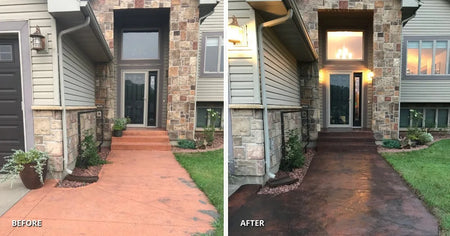
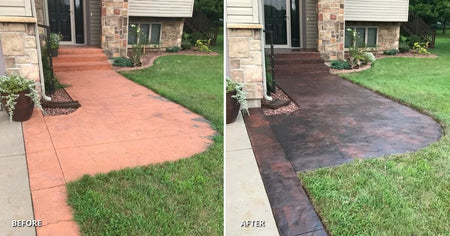
Chalky pinkish-orange to rich rusty iron
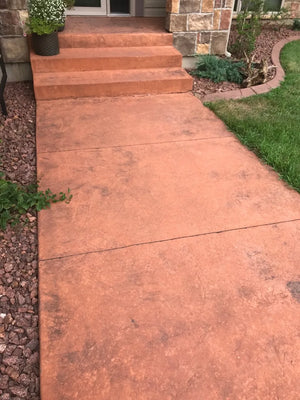
Stephanie Wallace inherited a bright pinkish-orange stamped walkway and driveway edging when she bought the house. This project won our August 2021 contest, and her notes are unusually specific about what actually worked.
Problem
Inherited chalky pinkish-orange stamped concrete
Product
EasyTint™ solvent-based tinted sealer, rusty iron tone
Prep
Soy Gel Stripper for old sealer, then ProClean Degreaser™; CitrusEtch™ where absorption failed
Application
Two coats with a 1/2 in. nap roller, one per day
Finish
One coat EasySeal™ after eight hours' cure
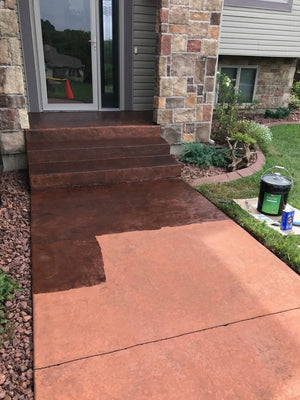
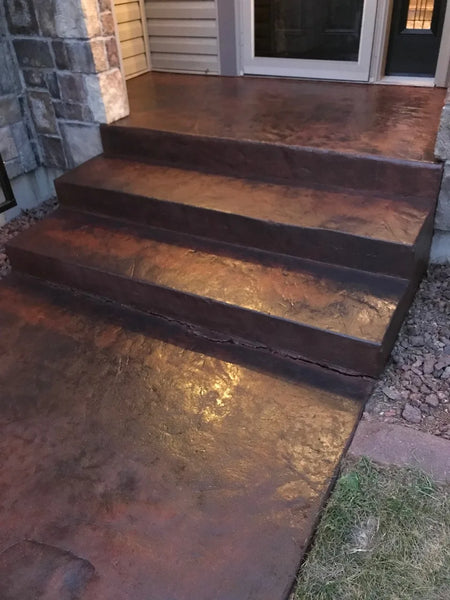
Before and after image of a stained concrete walkway being transformed from a pinkish-red color to a sleek and elegant golden charcoal hue.Before and after image of a stained concrete walkway being transformed from a pinkish-red color to a sleek, elegant and rich rusty iron color.
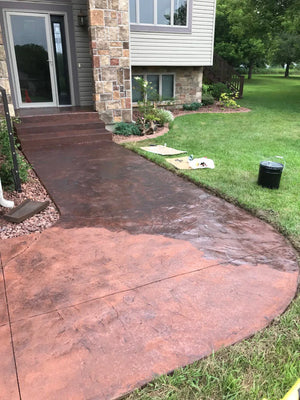
EasyTint™ Light Charcoal going on.The walkway before.The application in progress.
The finished walkway.The before-and-after together.
Her tips, which contradict our own instructions in one place
Use a 1/2 in. nap roller
We normally recommend 3/8 in. at most — she went thicker deliberately, so the sealer would run into the deeper wells of stamped concrete. On stamped surfaces this is sound
Do not fear roller lines
Despite the fast dry time, there were none
Edges
Squeeze it over them with the roller; hand-paint only the sections that are notably deeper
Mix properly
Shake and roll the container on the ground before opening, and shake again before every pour
Between coats
It dries enough to walk on without printing, but it is not cured
Buy extra
Thirsty concrete drinks more than the coverage figure suggests — of both tinted and clear sealer
Cleanup
Xylene while uncured; Soy Gel Stripper once cured
The method, step by step
1 · Mask
Cover anything at risk of overspray with plastic sheet
Pour a cup of water in several places. Not absorbed within five minutes? Etch with CitrusEtch™, neutralize, rinse thoroughly
5 · Dry completely
No shortcuts here
6 · Apply
Shake well, spray in slightly circular motions with irregular overlaps, shaking the tank side to side often so the color cannot settle. Thin coats — puddling is the enemy
7 · Second coat
After eight hours. Two thin coats maximum
8 · Seal
Eight hours after the last coat, one thin coat of EasySeal™
9 · Maintain
Re-protect every two years, or as needed
Pro tips: start spraying at a far corner so you always have a path out. If sealer pools or looks uneven, back-roll with a 3/8 in. nap roller wetted in sealer and wrung out. To stop droplets falling on the finished surface, put the sprayer tip straight into a bucket before you release the trigger.
Can I change the color of concrete that is already stained?
Yes. The project here took chalky pinkish-orange stamped concrete to a rich rusty iron with EasyTint™, a solvent-based tinted sealer — two coats with a nap roller, one per day, then a coat of EasySeal™ after eight hours.
How do I know the surface will accept it?
Test absorption before anything else. Pour a cup of water in several places — if it is not absorbed within a few minutes, the old sealer is still there and has to come off first. Strip paint or old sealer, degrease off the oils, dirt and stripper residue, then let it dry completely. No shortcuts on that last one.
Which roller should I use on stamped concrete?
A thicker nap than usual. We normally recommend 3/8 in. at most, but Stephanie went to 1/2 in. deliberately so the sealer would run into the deeper wells of the stamp — on a stamped surface that is sound. She reported no roller lines despite the fast dry time.
How many coats, and how often do I redo it?
Two thin coats maximum, eight hours apart, then one thin coat of sealer eight hours after the last. Re-protect every two years, or as needed.
How much should I buy?
More than the coverage figure suggests — thirsty concrete drinks more. Shake and roll the container on the ground before opening it, and mix properly each time you refill.
You are eligible for free shipping.Spend $0.00 more to reach free shipping!
Product Comparison
Description
Price
Vendor
Type
Product variants
Choosing a selection results in a full page refresh.
Opens in a new window.
Before You Checkout
EasyTint™ and OxiGrip™ are not compatible when used together directly. For slip resistance, use EasyTint™ as the color layer and apply OxiGrip™ only with a clear solvent based sealer as the topcoat.
Before You Checkout
AcquaTint™ and OxiGrip™ are not compatible when used together directly. If you need added slip resistance, apply AcquaTint™ as your color layer first, then use OxiGrip™ in a clear topcoat with AcquaSeal™ or HydroCryl™.