
Concrete pigment colors the concrete itself rather than its surface — you mix the powder into the batch before you pour, so the color runs all the way through. A chipped edge is still the right color, and nothing can wear off. This is the full current range, and the thing to understand first is that the number of shades comes from dosage as much as from pigment.
Prefer to listen? Shawna Turner covered the four numbers a colored truck pour needs before you can order pigment. The player is at the end of this article.
How to read these charts
Each row starts with a photograph of the raw pigment powder, then shows four cast samples of that same pigment at increasing dose. So 101-1 Evening Shadow and 101-7 Turkey Red are the same pigment — one at a pound per batch, the other at seven. That is why the range is so large without being complicated: 25 of the codes carry a full four-step ladder, which is 100 named shades, and White 205 adds one more at a single step — 101 named shades in all.
It also means you can move a color deliberately. If Merlot is close but not deep enough, you do not need a different pigment — you need more of the one you have.
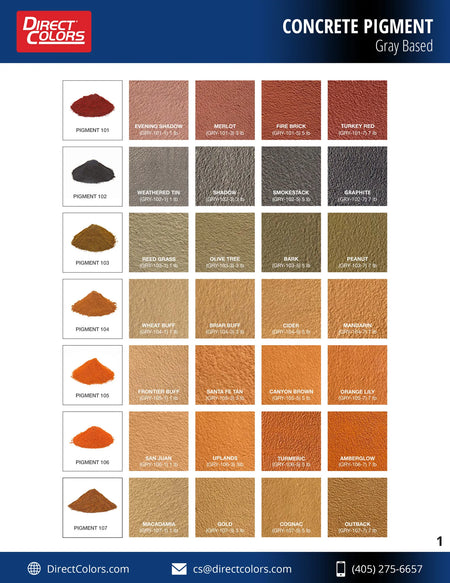
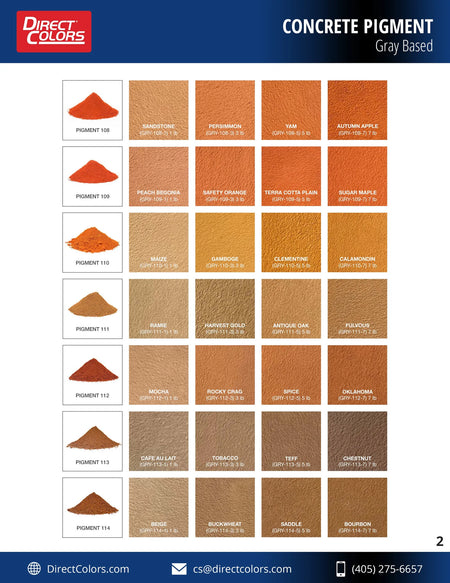
Gray-based pigment chart, pages 1 and 2 — pigments 101 through 114.
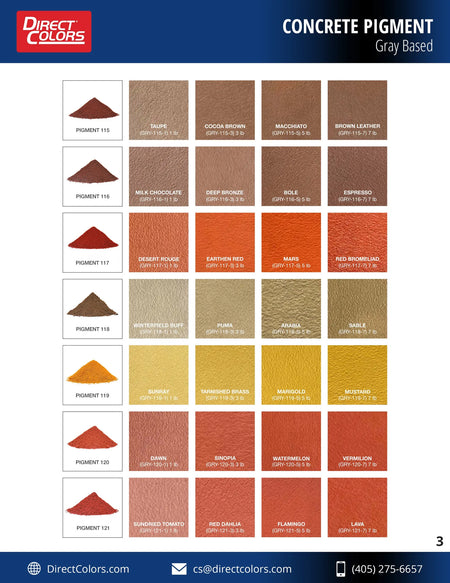
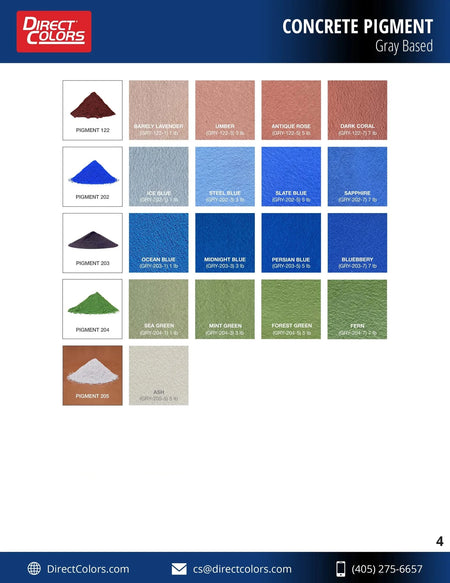
Pages 3 and 4 — pigments 115 through 205, including the blues and greens.
How the samples were made
Every sample on these charts was cast using gray Portland cement mixed with Direct Colors powder pigment and sealed with a satin sealer. That matters, because it tells you exactly what the photographs represent and what they do not.
The full range, by family
Thirty-four color codes. Twenty-five of them carry the full four-step ladder — reds and earth tones from 101 to 122, blues at 202 and 203, and green at 204. White 205 is sold at one step. The remaining eight are single colors with no ladder.
Reds, earths, browns and golds — 101 to 122
- 101 Evening Shadow · Merlot · Fire Brick · Turkey Red
- 102 Weathered Tin · Shadow · Smokestack · Graphite
- 103 Reed Grass · Olive Tree · Bark · Peanut
- 104 Wheat Buff · Briar Buff · Cider · Mandarin
- 105 Frontier Buff · Santa Fe Tan · Canyon Brown · Orange Lily
- 106 San Juan · Uplands · Turmeric · Amber Glow
- 107 Macadamia · Gold · Cognac · Outback
- 108 Sandstone · Persimmon · Yam · Autumn Maple
- 109 Peach Begonia · Safety Orange · Terracotta · Sugar Maple
- 110 Maize · Gamboge · Clementine · Calamondin
- 111 Ramie · Harvest Gold · Antique Oak · Fulvous
- 112 Mocha · Rocky Crag · Spice · Oklahoma
- 113 Cafe Au Lait · Tobacco · Teff · Chestnut
- 114 Beige · Buckwheat · Saddle · Bourbon
- 115 Taupe · Cocoa Brown · Macchiato · Brown Leather
- 116 Milk Chocolate · Deep Bronze · Bole · Espresso
- 117 Desert Rouge · Earthen Red · Mars · Red Bromeliad
- 118 Winterfield Buff · Puma · Arabia · Sable
- 119 Sunray · Tarnished Brass · Marigold · Mustard
- 120 Dawn · Sinopia · Watermelon · Vermilion
- 121 Sundried Tomato · Red Dahlia · Flamingo · Lava
- 122 Barely Lavender · Umber · Antique Rose · Dark Coral
Blues — 202 and 203
- 202 Ice Blue · Steel Blue · Slate Blue · Sapphire
- 203 Ocean Blue · Midnight Blue · Persian Blue · Blueberry
Green and white — 204 and 205
- 204 Sea Green · Mint Green · Forest Green · Fern
- 205 Ash — White 205 is titanium dioxide rather than an iron oxide, and it is sold at one dose step rather than four
Single colors — no dose ladder
Eight codes are sold as one color rather than as a four-step ladder. They are not on the charts above, and there is no -1/-3/-5/-7 suffix to choose.
- 206 Charcoal
- 215 Gray
- 216 Khaki
- 217 Light Charcoal
- 224 Silver Gray
- 226 Tan
- 231 Eagle Gray
- 294 Buff
That is how the range adds up: 25 laddered codes, White 205, and 8 single colors makes 34 codes, and 25 × 4 + 1 makes 101 named shades.
Pigment is sold by the base number in 1, 5, 10 and 25 lb bags, with a 4 oz sample size and quantities above 25 lb quoted individually — you choose the dose when you mix. Use the calculator and shade picker to work out how much you need for your pour, or start with a pigment sampler to see the powders in person.
Common questions
What is the difference between concrete pigment and integral color?
There isn't one — pigment is the product, integral color is what it does. Concrete pigment added to the mix before the pour colors the slab all the way through, so if the surface chips later the color looks the same top and bottom. That through-body color is why many people choose it for outdoor concrete over a surface treatment.
What do I need to tell you before ordering pigment for a truck pour?
Four numbers, all of which your ready-mix plant can answer. The psi (most slabs are 3,000–4,000), the percentage of fly ash in the mix design, the number of yards being poured, and your color from the chart. The psi and fly ash figure together tell us how much actual cement is in the mix, which is what the dose is calculated against.
Why does fly ash matter for colored concrete?
It replaces cement, and pigment works on cement. Ready-mix suppliers use increasing amounts of fly ash because it is cheaper, so the dose may need increasing to compensate. It matters twice over if you also intend to acid stain later — a high fly-ash slab reacts poorly with acid stain, which is a separate problem from getting the integral color right.
What does a "3 lb color" mean?
It is the pigment concentration that shade requires. A 3 lb color takes three times as much pigment per unit of cement as a 1 lb color — Briar Buff, for instance, is a 3 lb color. The rating is on the color chart, and it is the second input every calculator asks for after the cement weight.
Listen to this episode
Direct Colors DIY Home Improvement · Episode 4
Calculating Pigment Colors for Any Concrete Project
Amie Nolen and Shawna Turner · 13 min 06 sec · read the full transcript
What’s Next
- Gray or white cement → White Cement vs Gray Cement: How the Base Changes Pigment Color
- Why more is not darker → Why More Concrete Pigment Is Not Always Better
- Chemistry by code → Concrete Pigment Chemistry Explained
- Specifying it → How to Specify Concrete Pigment Under ASTM C979
- A shade between two → How to Develop a Custom Shade
- Working out quantities → How Much Concrete Pigment Powder per Cement Sack or Bag?
- How to use it → How to Integrally Color Concrete · Pouring Colored Slabs
- Other cement-based products → Stucco · Grout · Mortar
- Cast something with it → DIY Concrete Craft Projects · Pigment Projects
- Why pigmented concrete still fades on top → Stamped Decorative Concrete
- Shop → Concrete Powder Pigment · Shade Picker · Pigment Sampler


