
Staining pavers is a five-step job, and four of those steps are easy. The one that decides the outcome is understanding that paver stain is semi-transparent — so what you get is your color over the color already there, not instead of it. Everything below follows from that.
Prefer to listen? Shawna Turner covered the wet test, eroded aggregate, and restoring sun-faded pavers. The player is at the end of this article.
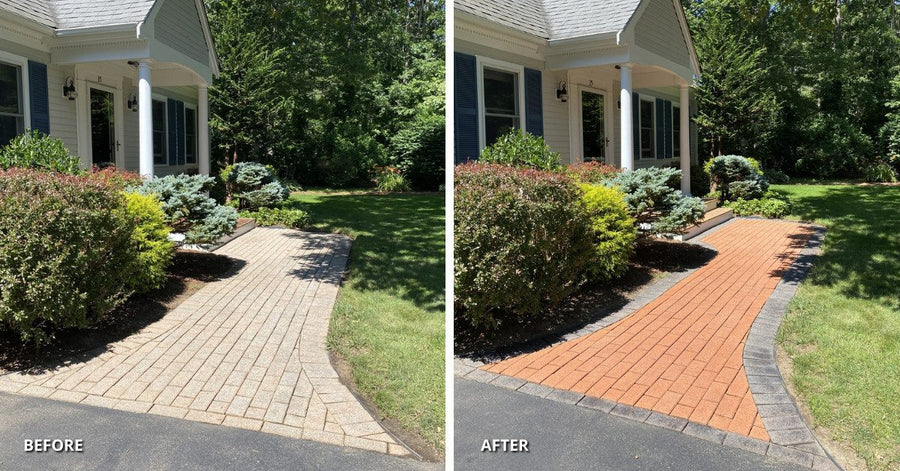
The same patio before and after Portico™ Terracotta and Charcoal.
Jump to: The five steps · Can you change paver color? · Which stain · Efflorescence · Choosing the sealer · Already sealed? · FAQs
The five steps
- Surface cleaning. Get the pavers thoroughly clean — all dirt, dust, stains and anything else that could affect the finish. ProClean Degreaser™ as the last step before staining.
- Stain preparation. Pour your chosen paver stain into a pump sprayer.
- Stain application. Apply two coats evenly, in a circular motion.
- Add layers only if you need to. Decide whether you need more to reach the color you want — but more than three layers leads to adherence problems, where the stain sits on the surface instead of bonding to it. If three coats has not got you there, the answer is a different color, not a fourth coat.
- Seal it. Once the stain has settled and dried, spray or roll two even coats of sealer, letting each dry completely. That protects the color and is most of what determines how long it lasts.
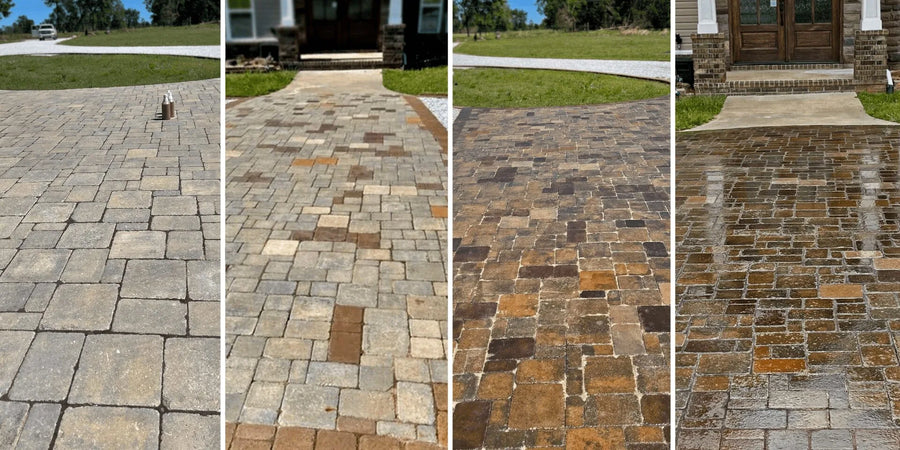
Faded pavers, the first color pass, building the color, and the sealed result.
Can you actually change the color of pavers?
Yes, with stain and a basic grasp of color theory. Complementary colors neutralize the shade that is already there, which is how you move pavers across the color wheel rather than just deepening what they are. The caveat is that the original color, the porosity and the composition of your pavers all influence the result, sometimes in ways you would not predict. Test on a small hidden area first. Every time.
Why the same stain looks different on brick than on concrete
This is the clearest demonstration we have of semi-transparency, and it explains most surprises. The same Portico™ Charcoal, on brick pavers and on concrete pavers — brick has brown undertones, so charcoal over it goes warm; concrete is a neutral gray, so the same charcoal goes cool. Neither is wrong. Both are the stain doing exactly what a semi-transparent product does.
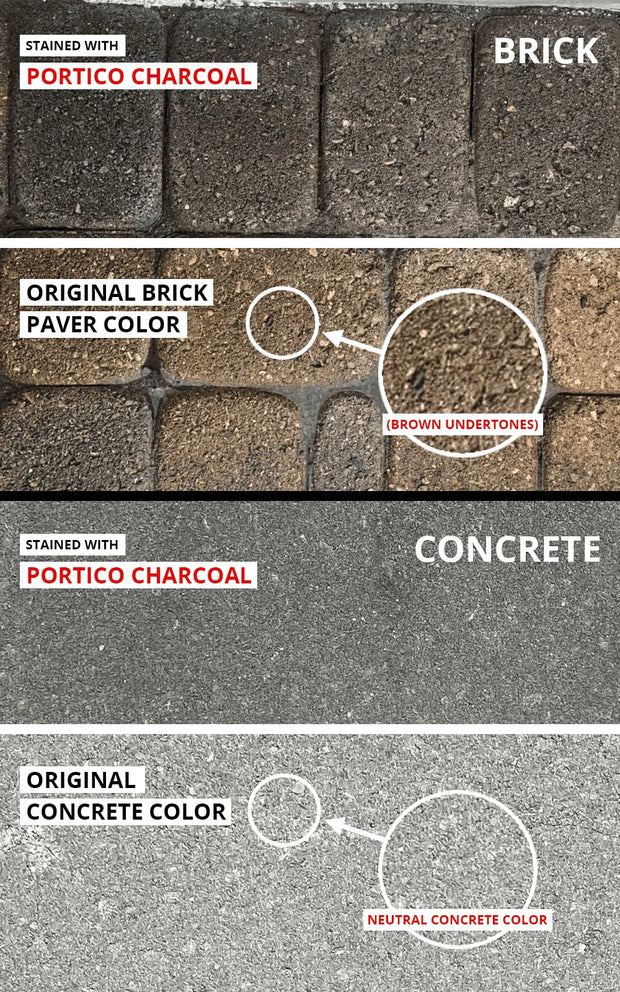
The same Portico™ Charcoal on brick pavers and on concrete pavers — the undertone underneath decides the result.
Red pavers to gray, specifically
The most common request we get. You need a paver stain or a tinted sealer in a gray shade — Portico™ in Gray, Silver Gray, Eagle Gray, Light Charcoal or Charcoal, or EasyTint™ if you want more coverage. Clean the surface thoroughly, prepare the product per its instructions, and apply it uniformly in a circular motion — or with a roller, keeping the application even. Let each layer dry completely before adding the next, and build to the gray you want rather than trying to get there in one pass. Then seal.
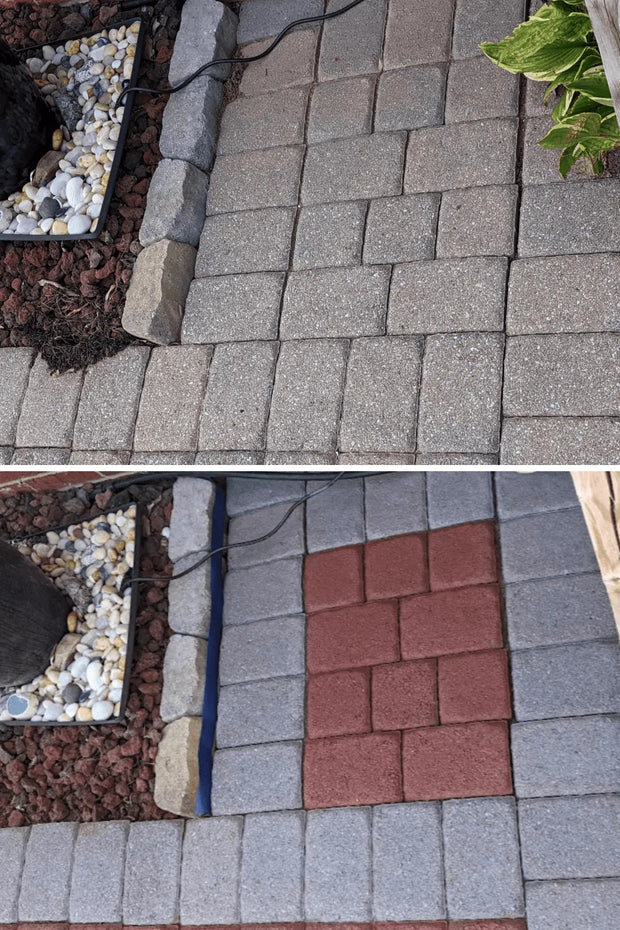
Changing paver color with stain — the original color underneath still shapes where you land.
Which stain, and why pigment concentration matters
For pavers you want a stain with a high pigment concentration, because you are fighting an existing color rather than coloring bare concrete. Portico™ Paver Stain is built for it: a highly saturated exterior stain made specifically for coloring concrete pavers, in 21 colors.
Two properties worth being clear about. It can be applied over previously stained and sealed pavers, adding a tint to the surface while still letting the texture show through. And it is not opaque — unlike paint, it will not cover up the existing texture of the pavers, which is the whole reason stained pavers still look like pavers.
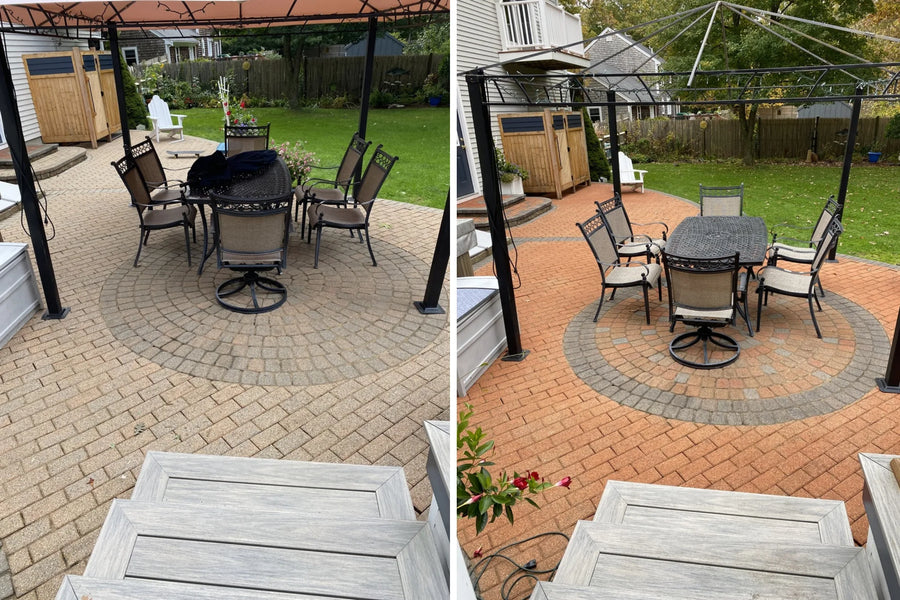
Faded paver color restored with Portico™.
If you would rather work water-based, PaveWave™ Paver Stain covers the same job with easier cleanup, and trial systems exist for both lines.
Efflorescence, and staining a brick patio that has it
An old brick patio marked with efflorescence and damaged cement grout, brought back with Portico™ Milano Red as the main color. The first step was removing the efflorescence — high-pressure spraying cleared it and prepared the surface. Then each brick was stained individually with sponge brushes, which is as slow as it sounds. Two coats of satin sealant went on afterwards.
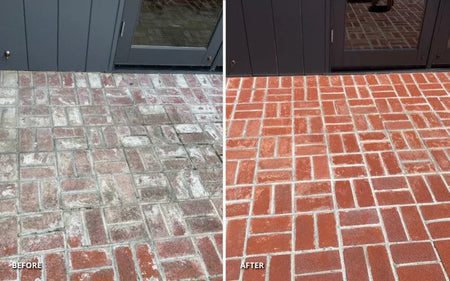
A brick patio with efflorescence and grout damage, before and after Portico™.
One note on that project: it originally used a second Portico™ color that we no longer stock, so the two-tone effect shown would be built today from the current range. Milano Red and Terracotta get very close.
Choosing the sealer, which decides how long it lasts
The color is the stain’s job. Longevity is the sealer’s. For stained pavers you want high acrylic content — 25% solids or more is the benchmark — because acrylic is what resists fading and wear. That matters most exactly where pavers live: driveways, walkways and patios in regular use and full weather.
EasySeal™ is our solvent-based acrylic, UV-stabilized with both a UV absorber and a light stabilizer so it does not yellow, chalk or break down after a season of sun. HydroCryl™ is the water-based option where fumes are a concern. Either way, plan on resealing exterior pavers every 2 to 3 years.
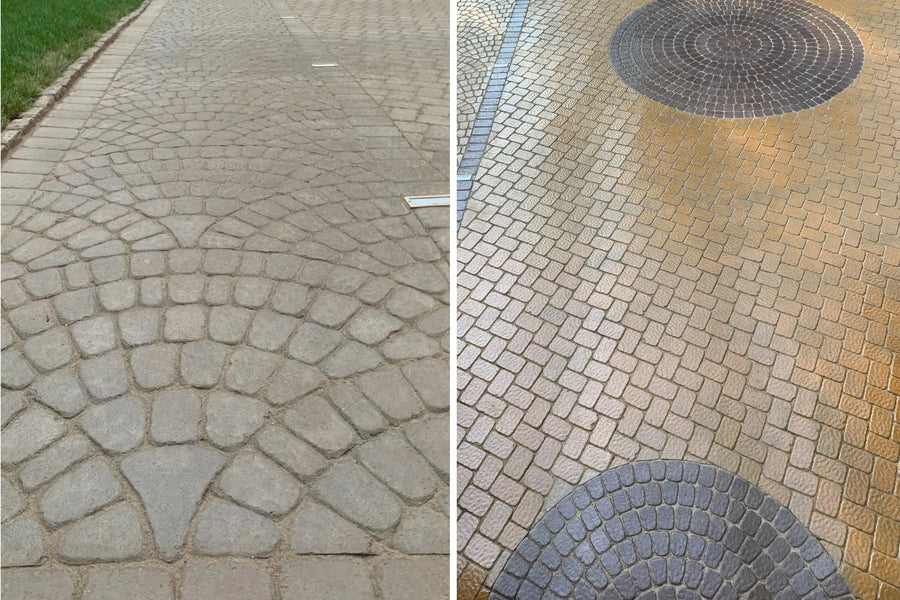
A paver driveway finished with a colored sealer.
A 15-year-old driveway, done in two products
One homeowner recolored their 15-year-old driveway by staining and sealing the border, half-moon and circular pavers with Aztec Brown Portico™ finished in High Gloss EasySeal™, then took the rest of the driveway in EasyTint™ Goldenrod Gloss. Stain for the detail work, tinted sealer for the field.
Are your pavers already sealed? A three-step test
This changes what you can do next, so find out before you buy anything.
- Pour a small amount of water onto the surface of the pavers.
- Watch what it does. Absorbed easily? Probably never sealed. Beads on the surface, or takes a while to soak in? They have been sealed before.
- Repeat in a few different areas, because one spot is not a result — pavers seal unevenly and wear unevenly.
If they are sealed, the old sealer has to come off before a stain will penetrate — Destiny™ Stripper lifts acrylic, urethane and epoxy coatings. Or work with it instead: Portico™ will tint over a previously sealed surface, and EasyTint™ is designed to go on as a colored sealer coat. The full diagnostic sequence is in our surface preparation guide.
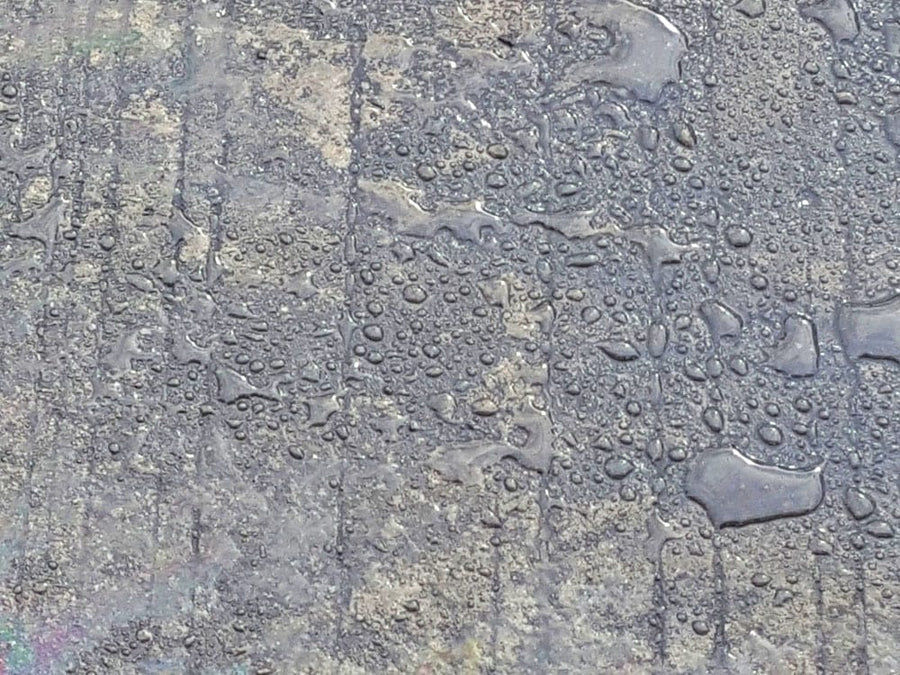
Water beading on a sealed surface — the answer to whether your pavers have been sealed before.
Common questions
How do I know whether my faded pavers need color or just sealing?
Pour water on them. Wetting concrete is a fair preview of how it will look sealed, so if you are happy with the color when it is wet, a satin solvent-based sealer alone will probably get you there. If it still looks flat and faded wet, you need to add color. It takes two minutes and can save you the cost of a whole staining project.
Can I acid stain old, weathered pavers?
Often not. Acid stain needs minerals in the surface to react with, and years of sun and weather erode that layer away — even on pavers that were never sealed. The rule of thumb is to look for exposed sand or stone aggregate: if you can see it, especially across a wide area, acid stain will disappoint you. Antiquing™ is the better bet there, and it works over previously sealed concrete too. Test on one actual paver before committing.
What should I use on brand-new pavers?
For a paver project today, start with the paver-specific lines: Portico™ (solvent-based, 21 colors) or PaveWave™ (water-based, 10 colors). EverStain™ also works well on smooth-finish new pavers if you want the mottled, reactive acid stain look. Multiple colors across different pavers is where the interesting designs come from.
How do I protect pavers I'm already happy with?
Seal them without changing them. ProSeal Li™ soaks in rather than forming a film, so it does not alter the color, and it helps against salt and freeze–thaw. It works best on smooth or lightly textured pavers. If you want the opposite — more shine and deeper existing color, particularly on flagstone shapes — use a solvent-based sealer instead.
Listen to this episode
Direct Colors DIY Home Improvement · Episode 36
Color Concrete Pavers for Patios, Walkways and Pool Decks
Reagan Smith and Shawna Turner · 7 min 21 sec · read the full transcript
What’s Next
- Fifteen finished projects → Stained Concrete Pavers: Before & After
- Cast and stain your own → Staining Quikrete WalkMaker Pavers
- Brick rather than pavers → How to Change Your Brick Color
- Prep and stripping → Concrete Surface Preparation
- Shop → Portico™ · PaveWave™ · EasyTint™ · Trial Systems


