
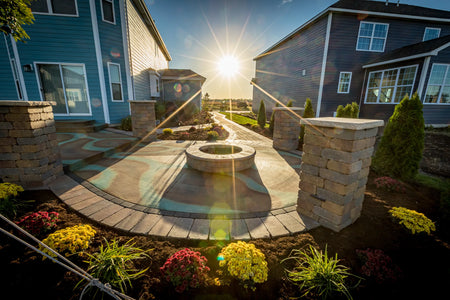
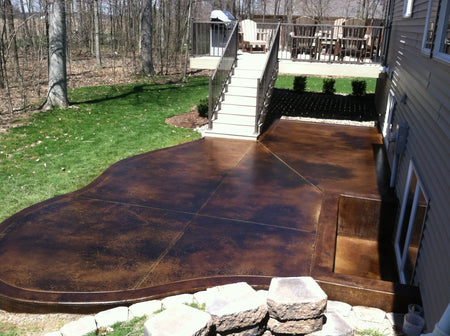
Scott Orr won our September 2021 contest with this backyard cookhouse floor, and it is worth reading because he documented one decision he would make differently — which is rarer and more useful than a list of things that went right. Fiberglass-reinforced concrete, 60 days of cure, and then English Red and Azure Blue acid stain with a hand-made veining technique.
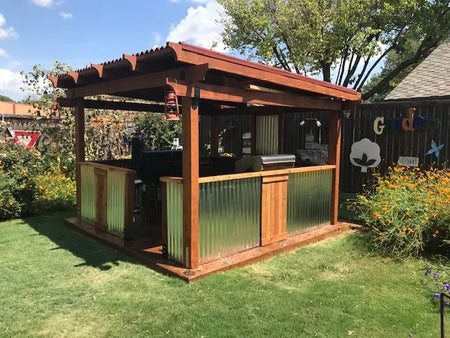
The finished cookhouse floor in English Red and Azure Blue EverStain™.

The regret worth learning from
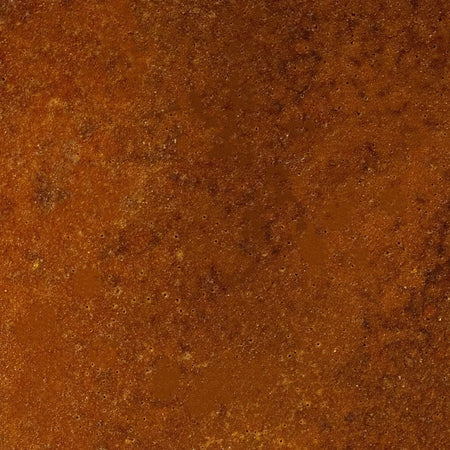
“If you want a marbling effect, use a lighter color for the first coat instead of cutting with water. You will get a better reaction with undiluted acid. This is the only thing I wished I had done differently.”
— Scott Orr
That is a genuinely important distinction. Diluting acid stain with water weakens the reaction, not just the color — you get less mineral development and a flatter result. If you want two tones, use two colors at full strength rather than one color at two dilutions. (Compare the bathroom project in stained concrete bathroom floors, where four dilutions of one color was the goal — the difference is that a subtle tonal range and a marbled contrast are two different targets.)
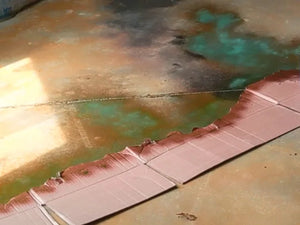
The veining, and the Miracle-Gro
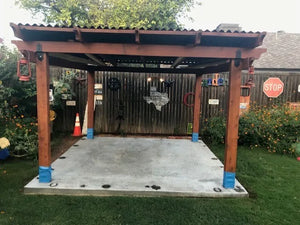
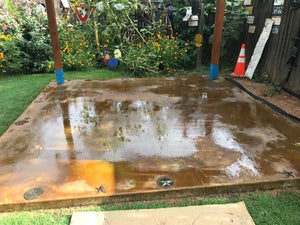
After the base was neutralized and rinsed, he applied about two-thirds of a quart of undiluted Azure Blue with a small spray bottle, using the torn cardboard as an edge guide to get a vein effect. Then the trick: one tablespoon of Miracle-Gro powder mixed into the remaining third of the Azure Blue, which produced a much deeper blue. He spritzed and gently poured that over parts of the veining, and finally went back with the leftover English Red to darken areas that had come out lighter than he wanted.
Both techniques have their own full write-ups: six ways to make a vein and why Miracle-Gro intensifies blue.
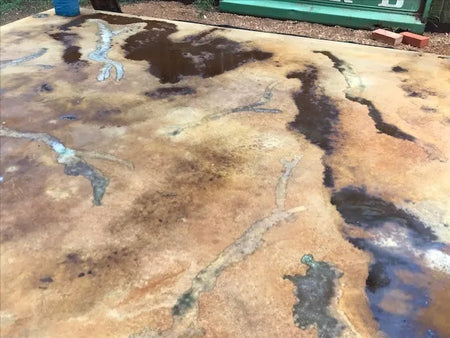
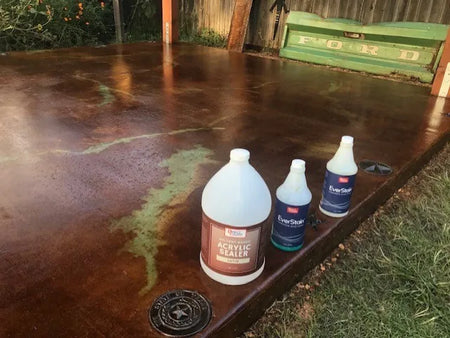
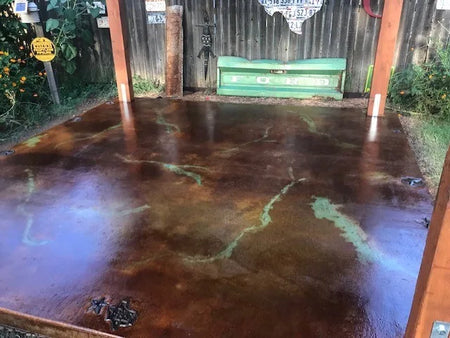
The finished floor — English Red, Azure Blue, and Miracle-Gro deepened veins.
Two tips about heat, and one about rollers
— Scott Orr
Temperatures were in the mid-80s to low-90s, so the stain dried in about six hours and the reaction had finished. More on working in heat in summer staining and sealing.
— Scott Orr
Safety, in his words: long sleeves, pants, goggles and gloves whenever you are working with acid stain.
Cookhouse Floor: FAQs
How long did this new slab cure?
60 days — it was new fiberglass-reinforced concrete, and he waited well beyond the 30-day minimum before staining.
How was the marbled base built?
Two quarts of English Red diluted 1:1 for the first coat, then a second coat undiluted to marble it. The veining went on afterwards: undiluted Azure Blue through a piece of cardboard with ripped edges.
How do you work in real heat?
He hung tarps to keep the sun off the slab after applying the stain, so the reaction had time to work rather than being dried out. In Texas that was the difference between color and no color.
What was the sealer schedule?
Two coats of solvent-based acrylic satin, 24 hours apart, and then stay off it.
What’s Next
- The techniques he used → Veining · Miracle-Gro for Blue
- Working in heat → Summer Staining and Sealing
- The method and the colors → How to Apply Acid Stain · Azure Blue · English Red
- Shop → EverStain™ · Trial Kits · EasySeal™


