
Marble on a floor costs what marble costs. A marble effect in acid stain costs the price of two or three quarts, and because acid stain reacts with the concrete rather than coating it, the result has genuine depth — the mottling is happening inside the slab, not printed on it. That is why it holds up next to real stone in a way paint never does.
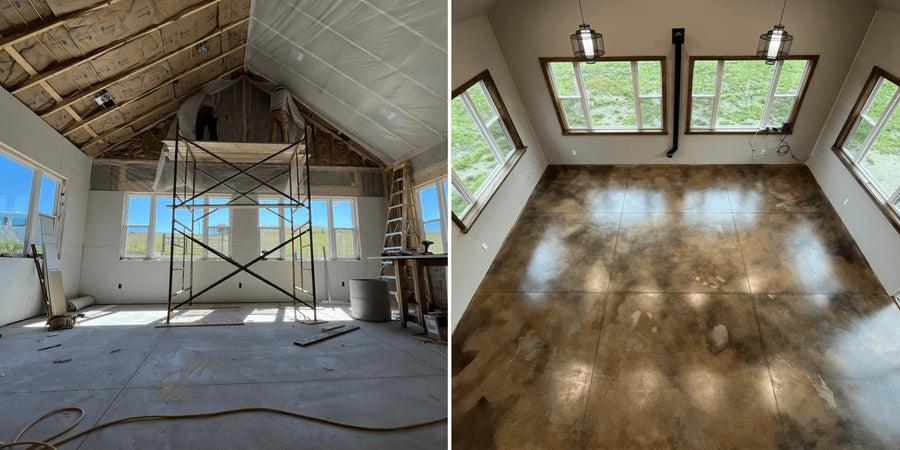
The same room before and after — bare slab to a marbled acid-stained floor.
How the layering works
The common approach is to layer different acid stain colors over one another. Start light and build darker, because a dark color will cover a light one and you cannot go back. The interesting exception is that some of the blue-green stains — Azure Blue and Seagrass — stand out nicely even over the darkest underlying stain, so they are worth experimenting with as a top layer rather than a base.
An acid stain trial kit on an offcut or a hidden corner is how you find your combination without gambling a floor on it.
The method, in four steps
- Prep the surface. Clean, dry, and free of any coating or sealer. Use a grinder to take out imperfections or unevenness — see how to prepare concrete for acid staining.
- Apply the stain. No mixing needed. Pump-up sprayer, working in small sections and overlapping the edges for even coverage. Then work the surface with faux techniques — ragging or sponging — to break the color into stone-like variation. Full method in the step-by-step guide to applying acid stain.
- Neutralize. Once the color has had its time, a neutralizing solution stops the etching reaction. Times vary by color — check activation times.
- Seal. Once completely dry, a sealer protects the surface and deepens the color. Then, indoors only, you can buff, polish or wax to whatever level of gloss you want — and gloss is a large part of what makes it read as marble.
Two floors, two palettes
Subtle: Coffee Brown, Malayan Buff and Seagrass
Warm browns with soft green undertones, which gives the floor a natural, earthy feel that suits a rustic or industrial room. The first coat of sealer is what brings it to life — it adds a light sheen that pulls out the mottled, blended hues that look flat while the floor is bare.
Striking: Coffee Brown, Cola and Desert Amber
Three browns interacting, with soft transitions between the light and dark areas, and darker veins running through to add flow and depth. The veining mimics the organic patterns in natural stone and in wood grain, and the overall effect sits close to worn leather — rustic but polished, which is why it works so well in a man cave or a den.
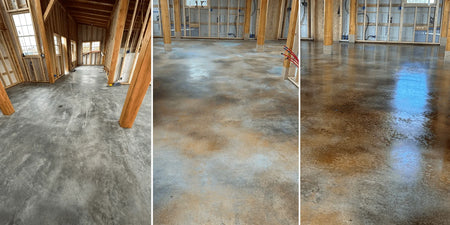
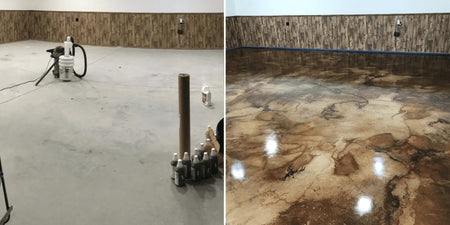
For deliberate veins rather than incidental ones, the six masking methods in concrete veining with acid stain will get you there — torn cardboard, toilet paper, plastic wrap and flowing water all produce a more marble-like vein than freehand spraying does.
Marble Look: FAQs
Which color goes down first?
The lighter one, always. A dark color will cover a light one and you cannot go back. Start light and build darker.
Is there an exception to that rule?
Yes — some blue-green stains read clearly even over the darkest underlying color. Worth testing if that is the effect you want.
Do I need to mix or dilute the stain?
No. Acid stains come ready to use straight from the bottle. Apply with a pump-up sprayer in small sections, overlapping the edges, then work it with a rag or sponge for effect.
What does the finished floor need?
Neutralize, seal, and then optionally buff, polish or wax — indoors only for the wax.
How predictable is the result?
Honestly, not very. This is not an exact science: concrete type and condition change the outcome, which is why the sealer coat is also the moment the floor first looks like itself.
What’s Next
- Deliberate veins → Concrete Veining with Acid Stain
- The related look → Worn-Leather Look Floors · Concrete That Looks Like Wood
- Layering, in depth → Two or More Acid Stain Colors
- Marble on a countertop → Acid Staining Concrete Countertops
- Shop → EverStain™ · Trial Kits · ProWax Polish™


