
Cement and concrete are not the same thing, and the difference is the same as the one between flour and bread. Cement is an ingredient. Concrete is what you get when you mix that ingredient with others. Almost every other confusion about the material clears up once that is straight.

A single city street contains hundreds of different uses of concrete.
What cement is
Cement is a manufactured product made by a closely controlled chemical combination of specific ingredients. Quarried limestone, clay and marl go into a kiln, are heated to extreme temperatures until they form a hard substance, and are then ground into a superfine powder. How fine? One pound of cement contains around 150 billion grains.
You will constantly see “Portland cement” on bags and in specifications. It is not a brand name; it is the generic term for the most common type of cement used in concrete, in the same way “sterling” refers to a grade of silver rather than a manufacturer.
What concrete is made of
For a material this strong and this versatile, the recipe is startlingly short: aggregates (sand and gravel), water, and cement. That is all. The cement and water combine into a paste, and that paste is mixed through the aggregate.
That last point is worth sitting with, because it is the opposite of how nearly every other building material behaves. The word itself carries it: concrete comes from the Latin concrescere, meaning to grow together.
Why it is used more than anything else
Only one material on earth is used in greater quantity than concrete, and that material is water. Its dominance comes down to two things: versatility and affordability. It can be formed into any size or shape you can build a mold for, and the ingredient list is cheap.
Beyond that it is durable (unaffected by rust or rot), long-lasting, low maintenance, fire resistant, straightforward to work with, among the safest building materials available, and it has excellent compressive strength under heavy loads. Which is how the same material ends up in highways, high-rises, backyard patios and kitchen countertops.
Is concrete energy efficient?
Yes, and by more than people expect. Concrete’s thermal mass slows heat transfer through walls, keeping a house cooler in summer and warmer in winter. Concrete buildings also have far fewer air leaks than wood-frame structures, and air leaks are a major source of energy loss.
The figure: concrete’s thermal mass properties can save 5 to 8% in energy costs compared with materials like softwood lumber. It is also 100% recyclable.
The types of concrete
Ready-mix accounts for almost three-quarters of all concrete use, roughly 260 million cubic yards a year in the United States. It is a custom-made solution: prepared in a factory to exact specifications for a particular job, then delivered by transit mixer (the trucks with the revolving drum) in a plastic, unhardened state ready to place. The advantage is consistency: a controlled environment, professional operators, the same equipment and practices every time.
Historical aside: in the early 1900s concrete was delivered in a horse-drawn mixer, with paddles turned by the cart’s own wheels as it rolled.
Not every project needs a truckload. Bagged mixes are readily available and are the right answer for small work: just add water. And since water is critical to final strength, follow the ratio on the bag rather than your instinct.
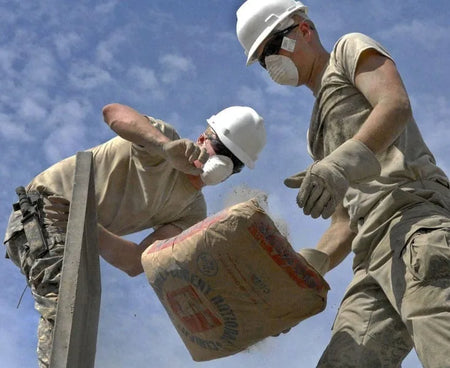

Choosing the right mix: PSI
PSI is compressive strength, and the right rating depends entirely on what the concrete has to carry.
The common brands, and what they are rated
At large retailers in the United States you will mostly meet four names. We do not sell concrete mix (we sell what goes on top of it), so this is simply what is on the shelf:
- Quikrete: Concrete Mix at 2,500 PSI, Crack-Resistant at 3,000, Fast-Setting at 4,000, and Quikrete 5000 at 5,000.
- Sakrete: Concrete Mix at 2,500 PSI, High-Strength at 4,000, and 5000 Plus at 5,000.
- Rapid Set: built around fast setting and high early strength rather than a headline PSI. Cement All reaches 3,000 PSI in one hour and up to 9,000 PSI at 28 days.
- ProSpec: professional-grade mixes and repair products aimed at commercial and industrial work, specified by performance rather than a general PSI.
Ratings and product lines change, so check the bag, the technical data sheet or the manufacturer before you order for anything structural.
How to reinforce concrete
Concrete shrinks and cracks: its volume changes as it dries, typically by about 1/16 of an inch over 10 feet. That is precisely why floors and pavement have joints cut into them: the joint gives the shrinkage somewhere to go, so the slab cracks in a straight line where you chose rather than randomly across the middle.
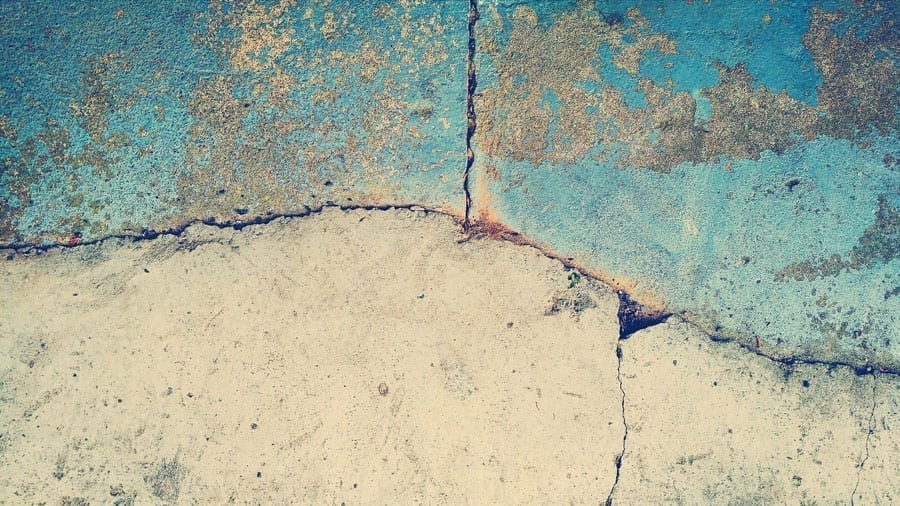
A cracked and rust-stained slab: what happens without adequate reinforcement or joints.
For a DIY countertop or similar cast piece, reinforcement protects against shrinkage cracking. Fiberglass netting and chopped fiberglass used as internal support strengthen the concrete, and the netting has a second benefit worth knowing: it significantly reduces the weight of a precast countertop, which matters enormously when it is time to lift the thing into place. Neither is something we stock; a concrete countertop supplier will have both. There is a full build in DIY concrete countertops.
What you can do with it once it is down
Do not write concrete off because you dislike gray. It takes color better than almost any other hard surface, at a fraction of the price of marble or granite, and the colorants are genuinely approachable for a first-time DIYer. Acid stain for reactive, variegated depth; dye for vivid, repeatable color; Antiquing™ for an aged patina; pigment to color it before it is even poured.
You can get faux wood floors, a marble effect, an antique patina, or a polished look, all covered elsewhere on this site. Maintaining any of it is a coat of sealer every few years. And if you want a different look later, that can be as simple as a new coating over the existing color, which is considerably less work than sanding and refinishing hardwood.
To color it in the mix rather than on the surface, start with our integral color guide. Not sure which colorant or finish suits the job? Trial kits answer that for a few dollars.
Concrete vs Cement: FAQs
What is the difference between cement and concrete?
Cement is an ingredient; concrete is the finished material. Cement is quarried limestone, clay and marl, kiln-fired and ground to a superfine powder. Concrete is cement plus aggregates plus water (roughly 10 to 15% cement, 60 to 75% aggregate and 15 to 20% water).
Is Portland cement a brand?
No, it is a generic type, like “sterling” for silver.
Does concrete dry or cure?
It cures. The binding is hydration, a chemical reaction between cement and water rather than drying, and it continues for years, so concrete keeps getting stronger as it ages.
Which PSI do I need?
2,500 for residential footings, slabs on grade and small walls; 3,000 for most residential and light commercial; 3,500 for reinforced foundations and structural support; 4,000 for commercial and industrial; 5,000 and above for specialized work like high-rises and bridges.
Why does concrete crack, and what are control joints for?
Because it shrinks as it cures, typically about 1/16 in. over 10 ft. Control joints give that movement somewhere to go, so the slab cracks where you chose rather than where it likes.
What’s Next
- Color it in the mix → How to Integrally Color Concrete · Pouring Colored Slabs
- Or on the surface → Acid Stain · Concrete Dye
- Make it look like something else → Wood · Marble · Polished
- Cast something → Countertops · Craft Projects
- Shop → Stains & Dyes · Pigment · Trial Kits


